Last Updated: May 2, 2026
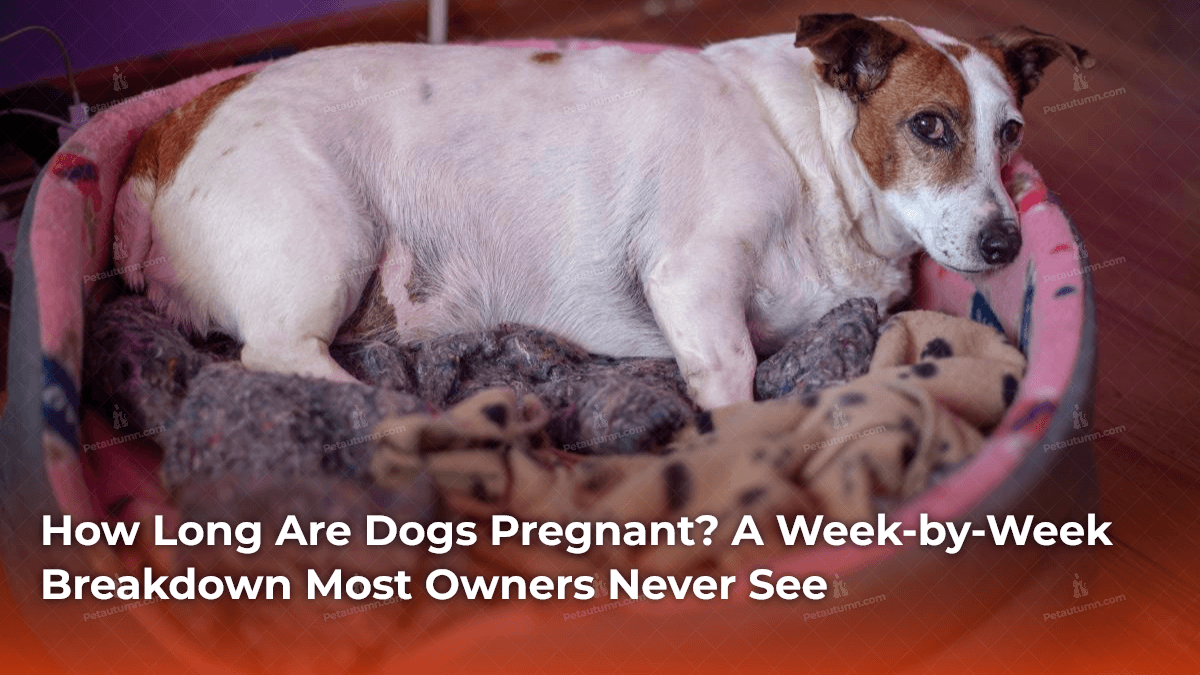
So your dog mated — planned or otherwise — and now you’re searching for answers at 11 PM wondering what exactly happens next. First, breathe. You’ve got roughly nine weeks, and knowing what’s happening inside her body at each stage makes everything a lot less terrifying.
The short answer? Dogs are pregnant for about 63 days. But that number is a little misleading, and most people are surprised to learn how little actually shows during the first month. Here at petautumn.com, we get a lot of panicked messages from dog owners who thought something was wrong because their dog seemed completely normal well into week four. Spoiler: that’s completely expected.
This guide covers the full timeline from fertilization to labor, plus how to confirm pregnancy, what to feed your dog at each stage, and the red flags that require an immediate call to your vet.
Key Takeaways
- Dog pregnancy averages 63 days from ovulation, but the actual range is 58 to 68 days from the breeding date.
- Visible signs typically don’t appear until weeks 4 to 5 — early stages look completely normal.
- Ultrasound can confirm pregnancy as early as day 25 to 28.
- Nutrition needs increase significantly starting week 5, not immediately after mating.
- A temperature drop below 100°F is the most reliable indicator that labor is 12 to 24 hours away.
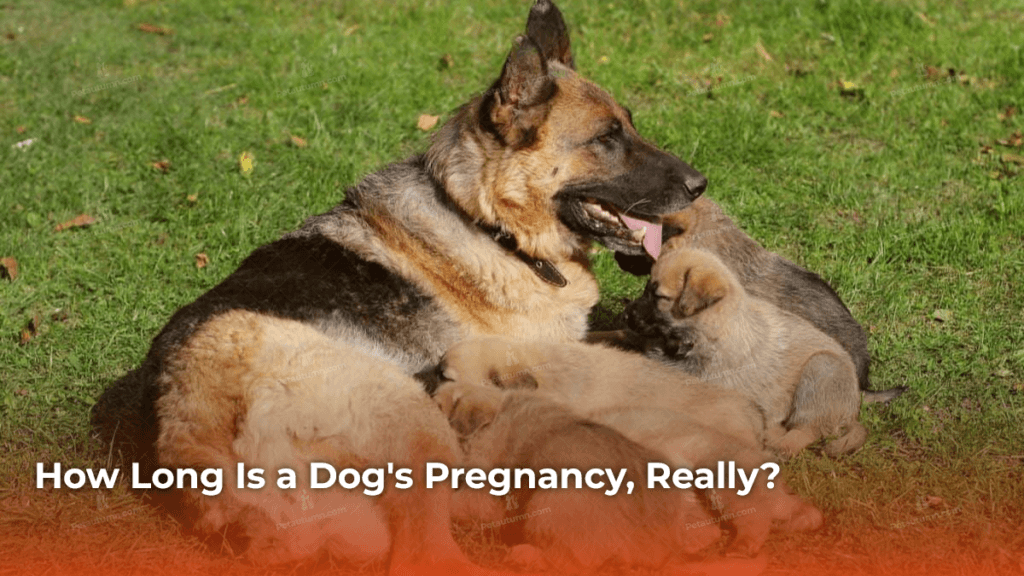
How Long Is a Dog’s Pregnancy, Really?
The 63-Day Rule (And Why It’s Not Always Exact)
Sixty-three days. That’s the number you’ll find everywhere, and it’s a solid baseline. But here’s where it gets complicated.
That 63-day figure is measured from ovulation, not from the day of mating. A dog can mate on Monday and not ovulate until Wednesday or Thursday. That gap is why pregnancies technically range from 58 to 68 days when counted from the actual breeding date, according to the American Kennel Club. Smaller litters tend to go longer; larger litters often arrive a few days early. The variability is real, and a single “due date” isn’t as clean as people expect.
How Vets Calculate the Due Date
Your vet has three main tools: progesterone testing, vaginal cytology, and ultrasound dating. Progesterone testing is the gold standard. It tracks hormone levels through the cycle to identify the exact ovulation day, giving you the most accurate timeline possible.
If mating happened without any pre-breeding testing — which is most of the time — vets estimate from the breeding date combined with early ultrasound measurements. Not perfectly precise, but reliable enough to give you a working window. Most vets aim for a two-to-three-day estimate rather than a single day.
Week-by-Week Dog Pregnancy Timeline
Here’s the full breakdown from fertilization to the final countdown.
| Week | Key Development | Visible Signs |
|---|---|---|
| Weeks 1-2 | Fertilization and rapid cell division | None |
| Weeks 3-4 | Embryo implantation, organ foundations begin | Subtle appetite shift, mild lethargy, possible morning sickness |
| Weeks 5-6 | Fetal organs and limbs develop rapidly | Belly rounding, increased appetite, early nesting |
| Weeks 7-8 | Puppies fully formed, coats and claws develop | Intense nesting, milk production begins, restlessness |
| Week 9 | Final growth, puppies reposition for birth | Temperature drop, food refusal, active nesting |
Weeks 1-2 — Fertilization and Early Cell Division
Nothing looks different. At all.
Your dog is acting normal, eating normally, and showing zero interest in signaling that something major is happening internally. Sperm meets egg within a few days of mating, and the resulting zygotes begin dividing rapidly as they travel down the fallopian tubes. They haven’t attached to the uterine wall yet. This is purely cellular — no external signs, no behavioral changes, nothing to observe.
Weeks 3-4 — Embryo Implantation and First Signs
Around day 16 to 18, the embryos implant into the uterine lining. This is when the pregnancy truly takes hold.
Some dogs experience a mild version of morning sickness around week 3 — reduced appetite, slight nausea, occasional vomiting. It usually resolves within a week. A few dogs become clingier or quieter than usual. Most, honestly, seem completely fine. A vet can attempt to detect pregnancy through abdominal palpation around day 28 to 35, but this should only be done by a professional. Pressing on a pregnant abdomen too early — or incorrectly — can cause harm.
When a fellow rescue volunteer in Austin went through this with her Labrador mix last year, she was convinced nothing had taken because her dog showed zero signs through week four. Weeks 3 and 4 are genuinely deceptive stages.
Weeks 5-6 — Fetal Development Kicks Into Gear
Week 5 is where pregnancy becomes undeniable. The fetuses have recognizable features now — limbs, faces, toes. Organ systems are developing fast. The belly starts to visibly round out, particularly on leaner or smaller breeds.
Appetite increases noticeably. Your dog may start gravitating toward quieter corners of the house, scratching at blankets. Early nesting. The fetuses have heartbeats by this point, which makes an ultrasound around week 5 genuinely moving to watch. (Ask us how we know.)
Weeks 7-8 — Getting Ready to Whelp
Fully formed. That’s the status of every puppy in the litter by week 7. Weeks 7 and 8 are about growth — adding coat, claws, and body weight. Your dog’s abdomen will be noticeably large, and large meals will become uncomfortable for her.
Nesting behavior intensifies significantly. She’ll scratch at bedding, seek enclosed spaces, drag laundry into corners. This is pure instinct. Set up her whelping box now — a clean, low-sided box in a quiet, warm room — before she picks her own spot (which will inevitably be your closet). According to the ASPCA, the whelping area should be kept around 85°F for the newborns’ first week.
This is also a smart time to revisit your dog’s vet visit schedule and confirm your prenatal checkup timeline before the birth date approaches.
Week 9 — Final Days Before Labor
Puppies are repositioning head-down in the birth canal. Your dog may refuse food entirely in the last 24 to 48 hours. She’ll be restless, panting, and almost entirely focused on her whelping spot.
Start checking her rectal temperature twice daily beginning around day 58. A normal dog runs between 101°F and 102.5°F. When that number drops below 100°F — usually around 98°F to 99°F — labor is typically 12 to 24 hours away. Write every reading down. That number is your most reliable clock.
How to Confirm a Dog Is Pregnant (and When)
Ultrasound vs. Hormone Testing vs. X-Ray
Three main options, each with its ideal timing.
| Method | Best Timing | What It Confirms | Approx. Cost |
|---|---|---|---|
| Relaxin Hormone Test | Day 22-27 | Pregnancy confirmed (yes/no) | $50-$80 |
| Ultrasound | Day 25-35 | Pregnancy + fetal heartbeats | $75-$150 |
| Abdominal Palpation | Day 28-35 | Possible embryo detection — vet only | Part of exam |
| X-Ray | Day 55+ | Puppy count and positioning | $100-$200 |
Ultrasound is the most useful early option — it confirms pregnancy and lets you see fetal heartbeats, which gives you a sense of viability. The relaxin hormone blood test is the earliest reliable confirmation available, detectable as early as day 22. And the late-stage X-ray? Non-negotiable if you want to know how many puppies to expect during whelping. Knowing the litter count tells you when the last one has arrived — critical information when you’re in hour four of labor at 2 AM.
What to Feed a Pregnant Dog at Each Stage
Nutrition is the most controllable variable in a dog’s pregnancy. And most owners make the same mistake: changing the food too early and in the wrong direction.
| Stage | Recommendation | Notes |
|---|---|---|
| Weeks 1-4 | Maintain current adult diet | Embryos are microscopic — no calorie increase needed yet |
| Weeks 5-6 | Gradually switch to puppy food or all-life-stages formula | Higher calorie density, DHA supports fetal brain development |
| Weeks 7-9 | Feed 3x daily; free-feed for large litters | Growing belly limits capacity — smaller, more frequent meals |
| Final 24-48 hours | She may refuse food entirely | Normal pre-labor behavior — don’t force feed |
The real calorie increase should start around week 5 and ramp up from there. By the final weeks, a dog carrying a large litter can need 50% more calories than her normal baseline. Puppy food — specifically formulas meeting AAFCO standards for “all life stages” — is the most practical switch. It’s calorie-dense and formulated with the extra protein and fat a pregnant or nursing dog needs.
If your dog already has dietary sensitivities, get that sorted before week 5. The nutritional demand of the third trimester is not the time to be experimenting with new proteins. More on managing those issues over in the novel protein guide for dogs with chicken allergies.
Smaller, more frequent meals in weeks 7 through 9 make a noticeable difference in how comfortable your dog is. Big belly plus big meal equals one miserable dog — trust us on this one.
Signs Labor Is 24-48 Hours Away
Watch for these together. It’s the combination that confirms things are actually moving.
- Temperature drop below 100°F (check twice daily starting day 58, and keep a log)
- Nesting intensifies — digging, rearranging bedding, refusing to leave her whelping spot
- Unexplained restlessness and panting with no physical exertion
- Complete food refusal in the final 24 hours
- Clear or slightly bloody vaginal discharge as active labor approaches
- Visible shivering or mild abdominal contractions
The temperature drop is the single most reliable sign. Once it goes below 100°F and holds there, start your watch. Have your vet’s emergency number in your phone before you reach week 8. Not because something is likely to go wrong — most whelping goes smoothly — but because if it does, you want that number in front of you immediately.
When to Call the Vet During Dog Pregnancy
Most dog pregnancies proceed without intervention. But certain situations require a call right away, no waiting.
Contact your vet immediately if you observe:
- Green or black discharge before any puppies are born (a small amount of green after a puppy is normal — before is an emergency)
- Active straining or pushing for more than 30 to 60 minutes without a puppy arriving
- More than 4 hours between puppies when you know from the X-ray that more are still inside
- Extreme lethargy, collapse, or signs of severe pain
- No labor signs by day 65 from the confirmed breeding date
The X-ray count matters enormously here. Knowing your dog is carrying six puppies versus two completely changes how you manage the whelping timeline. And once those puppies arrive, check out the best puppy foods in 2026 for when the litter starts transitioning to solid food around week three to four of their lives.
“The information on petautumn.com is for general informational purposes only and does not constitute veterinary advice. Pet health needs vary by breed, age, and individual condition. Always consult a licensed veterinarian before making decisions about your pet’s health, diet, or medical treatment. Pet Autumn is not affiliated with any veterinary organization, pet food manufacturer, or breeder. If you notice any concerning symptoms during your dog’s pregnancy or labor, contact your vet right away.”
Nine weeks sounds long until you’re in the middle of it. The first month feels like nothing is happening. Then suddenly the belly appears, the nesting starts, and you’re setting up a whelping box wondering where the time went.
Get a vet confirmed early, book your ultrasound around day 25 to 30, and schedule that X-ray before day 55. That information gives you control going into whelping night. Beyond the logistics, the rest comes down to watching your dog and trusting your instincts when something feels off.
Those puppies are about to have a great start — because their owner cared enough to actually learn what’s coming.
Sources
- American Kennel Club (AKC) — Dog Gestation Period
- ASPCA — Dog Care Resources
- AAFCO — Pet Food Labeling Standards
Frequently Asked Questions
Have more questions about your dog’s health? Visit petautumn.com for trusted pet care guides.

Dog care writer at petautumn.com. Visual Communication Design graduate (S.Ds) from Universitas Udayana. Covers dog breeds, behavior, training, and gear reviews. Dog dad to Meepo. Based in Austin, Texas.