Last Updated: May 01, 2026
Walk any major grocery store pet aisle and Iams is right there, sitting next to the paper towels and laundry detergent. It’s been on American shelves for nearly 80 years. Millions of dog owners buy it every week, not because they researched it, but because their parents fed it to the family dog, and the dog was fine. But “the dog was fine” isn’t actually a nutrition evaluation. That’s a habit.
So the real question is whether Iams holds up when you actually look at it. The team at petautumn.com went through the ingredient panels, compared the numbers to leading competitors, and dug into what veterinary nutritionists are saying about this brand heading into 2026.
This article covers what’s actually in the bag, how the two main product lines differ, how Iams stacks up against Purina Pro Plan, Hill’s Science Diet, and Royal Canin on both price and quality, and a straight answer on which dogs it genuinely suits — and which dogs would be better served by something else.
Key Takeaways
- Iams was founded in 1946 and is now owned by Mars Petcare, the world’s largest pet food company, through an acquisition finalized in 2014
- Iams features 20-plus dog foods across different formulas and life stages, though the company has discontinued a fair amount of its more expensive premium formulas over the years
- A 30-pound bag of Iams Proactive Health runs around $35-40, compared to roughly $60-70 for the same weight of Purina Pro Plan
- All main Iams dry formulas meet AAFCO nutritional standards and have undergone feeding trials, not just laboratory formulation
- Healthy adult dogs with no special dietary needs can do well on Iams; dogs with food sensitivities, allergies, or complex health conditions typically need something more targeted
What Is Iams, Really? A Quick Brand Overview
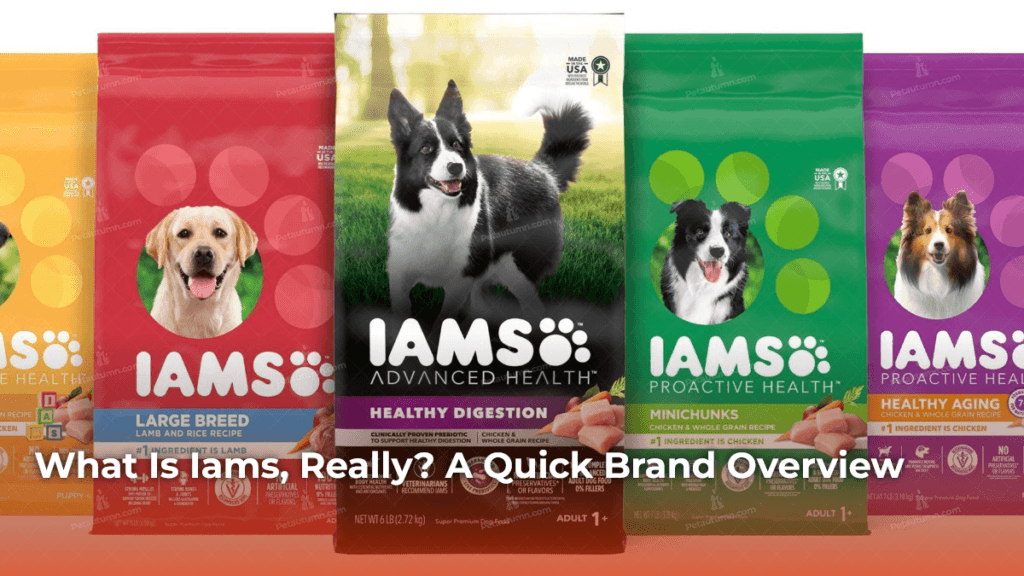
Paul Iams started the company in Dayton, Ohio in 1946 as an animal nutritionist who believed dogs deserved better protein than the table-scrap blends that dominated pet food at the time. For decades, Iams genuinely was a premium brand. It was one of the first companies to develop life-stage specific formulas, separating nutrition for puppies from adult and senior dogs. That was forward-thinking in the 1970s.
Procter and Gamble acquired the company in 1999, and then Mars Petcare bought Iams in 2014. Mars now distributes several giants in the pet food world, and Iams sits firmly in their accessible, mass-market tier. The original premium positioning has largely given way to competitive grocery-store pricing. Knowing that context helps set reasonable expectations before you open the bag.
Breaking Down Iams Ingredients: What’s Actually in the Bag
Protein Sources: Chicken, Lamb, or Salmon?
Most Iams dry formulas lead with chicken or chicken meal as the first ingredient. That’s a good start. Chicken meal is a concentrated protein source because the water content has been removed during processing, meaning more actual protein per pound versus listing whole fresh chicken first on the label.
The picture gets more complicated further down. Iams lists a real cut of meat as the top ingredient but includes meat by-product meals as the secondary animal protein source. Chicken by-product meal covers rendered parts including organs, necks, and carcasses. Not dangerous, not toxic — but it’s not the whole muscle meat you’d find in formulas at a higher price point. Most healthy dogs tolerate it well. Dogs with existing protein sensitivities sometimes don’t.
Iams does offer lamb and salmon varieties for dogs who struggle with poultry. One thing to check before assuming those are safe for strict allergy dogs: many of those formulas still include chicken fat in the ingredient list. A true poultry-sensitive dog could still react. If your dog has a confirmed protein intolerance, a dedicated novel protein formula is usually the cleaner route.
Fillers, Additives, and Controversial Ingredients
Carbohydrates in the Iams dry food line average around 49.5% as calculated on a dry matter basis, which is on the higher end for mainstream kibble. Corn grits and ground whole grain sorghum are the primary carb sources in most Proactive Health formulas. Neither is toxic, but neither is especially nutrient-dense, and the overall starch load is something to note for dogs prone to weight gain.
Beet pulp shows up in most formulas and gets unfairly lumped in with “fillers” by online critics. Most veterinary nutritionists actually view it positively — it’s a prebiotic fiber source that supports gut motility and stool quality. If your dog has signs of poor gut health, beet pulp is not the suspect.
Iams dry food avoids artificial preservatives, which is a genuine positive. Iams wet food, however, uses artificial coloring agents. If artificial dyes in pet food bother you specifically, that’s relevant for the canned product line. For dry kibble only households, it’s a non-issue. Most Iams formulas also include flaxseed and omega fatty acid sources, which support skin and coat health.
Iams Proactive Health vs. Iams Advanced Health: What’s the Difference?
These are the two main Iams dry dog food lines available in 2026, and the difference goes beyond marketing language.
| Feature | Iams Proactive Health | Iams Advanced Health |
|---|---|---|
| First Ingredient | Chicken or Chicken Meal | Chicken (whole, named) |
| Secondary Protein | Chicken By-Product Meal | Chicken Meal (no by-products listed) |
| Digestive Support | Beet pulp, fiber blend | Added probiotic strains |
| Artificial Preservatives | None | None |
| Best Suited For | Healthy adults, budget-conscious feeding | Dogs with mild digestive sensitivity |
| Approx. Price (30 lbs) | ~$35-$40 | ~$42-$52 |
Prices approximate as of May 2026. May vary by retailer and bag size.
Proactive Health is what you’ll find at Walmart, Target, and most grocery stores. Advanced Health is the step above it, available primarily at pet specialty stores and online. The probiotic addition in Advanced Health is worth noting for dogs with a history of loose stools or sensitive digestion. That said, the price difference per bag isn’t dramatic. If your dog has any digestive inconsistency, it’s probably worth the modest upgrade.
How Does Iams Compare to Purina, Hill’s Science Diet, and Royal Canin?
Price Per Pound Breakdown
This is where Iams makes its clearest case. The cost difference is real, and it compounds over a year of daily feeding.
| Brand | Approx. 30 lb Price | Price Per Pound | Est. Annual Cost (45-lb dog) |
|---|---|---|---|
| Iams Proactive Health | ~$35-$40 | ~$1.17-$1.33 | ~$210-$240 |
| Purina Pro Plan | ~$60-$70 | ~$2.00-$2.33 | ~$360-$420 |
| Hill’s Science Diet | ~$65-$78 | ~$2.17-$2.60 | ~$390-$470 |
| Royal Canin | ~$70-$85 | ~$2.33-$2.83 | ~$420-$510 |
Prices based on average US retail pricing as of May 2026. Annual cost estimated for a 45-lb dog consuming approximately 2.5 cups per day. Figures correct as of May 2026.
For a dog eating around 3 cups a day, that price difference between Iams and Purina Pro Plan represents a meaningful annual savings. For a 42-lb dog like Meepo, feeding Iams versus Hill’s comes out to roughly $180-230 saved per year. That’s real money, and for a dog with no special health conditions, it may not buy you anything meaningful in terms of actual nutrition outcomes.
Ingredient Quality Side-by-Side
Price tells one story. The label tells another.
| Brand | Primary Protein | Dry Matter Protein % | AAFCO Feeding Trials | Full-Time Nutritionists on Staff |
|---|---|---|---|---|
| Iams Proactive Health | Chicken + By-Product Meal | ~28% | Yes | Yes (Mars Petcare) |
| Purina Pro Plan | Chicken or Salmon (named) | ~30-32% | Yes | Yes (Nestle Purina) |
| Hill’s Science Diet | Chicken Meal (named) | ~20-23% | Yes | Yes (Hill’s Nutrition) |
| Royal Canin | Chicken By-Product Meal | ~26% | Yes | Yes (Mars Petcare) |
Source: Brand nutritional information and Dog Food Advisor analysis. Figures as of May 2026.
Something that surprises most people: Royal Canin, which is priced at the premium end of this table, also uses chicken by-product meal as a primary protein. Iams isn’t uniquely relying on lower-grade protein. The real differentiator between Iams and Purina Pro Plan is formula specificity, higher protein content, and the depth of documented research — not just ingredient aesthetics.
What Vets and Nutritionists Actually Say About Iams in 2026
Most veterinarians don’t have a strong position against Iams. The brand meets AAFCO nutritional standards, conducts feeding trials (not just formulation), and Mars Petcare employs full-time veterinary nutritionists. According to the American Veterinary Medical Association (AVMA), the most important indicators are whether a food is complete and balanced for the appropriate life stage, and whether a specific dog is thriving on it. On those terms, Iams qualifies.
Vets tend to recommend foods with documented research behind them — and Purina has more published research than Iams. That’s not just marketing; the science is real and matters more for dogs with specific health needs. For a healthy adult dog with nothing unusual going on, though, the gap in practical outcome is less meaningful than the gap on paper.
Honestly? Iams is a middle-of-the-road food that does its job for middle-of-the-road situations. The ingredient list looks exactly like what it is: a mass-market formula designed to hit a price point while meeting baseline nutritional requirements. That’s not a condemnation. It’s just useful information to hold when you’re standing in the pet food aisle deciding.
Who Should (and Shouldn’t) Feed Their Dog Iams
Iams works well for:
- Healthy adult dogs with no known food sensitivities or protein allergies
- Budget-conscious households, including multi-dog homes where premium food across all dogs isn’t financially practical
- Owners whose vet has confirmed their dog is maintaining healthy weight, coat condition, and digestion on their current food
- Dogs who have been eating Iams for years with zero issues (genuinely — if it’s working, the case for switching is weak)
Iams may not be the best fit for:
- Dogs with diagnosed food allergies or sensitivities to chicken by-products
- Senior dogs with joint, kidney, or urinary concerns — a more targeted formula tends to serve them better. If joint support is the issue, the best dog joint supplements in 2026 are worth reviewing alongside the food question
- Large-breed puppies who need carefully calibrated calcium-to-phosphorus ratios for proper bone development — see what vets actually recommend for puppy food before committing to any formula for a growing large breed
- Owners who prioritize minimal processing and whole-food ingredients — in that case, fresh dog food subscriptions like Ollie and The Farmer’s Dog represent a genuinely different category
The last recall Iams had was in 2013 — voluntary, with no known illnesses from the affected products. No major safety concerns have surfaced since. For owners who have been nervous about the brand’s safety history, that’s a reasonable reassurance.
“The information on petautumn.com is for general informational purposes only and does not constitute veterinary advice. Pet health needs vary by breed, age, and individual condition. Always consult a licensed veterinarian before making decisions about your pet’s health, diet, or medical treatment. Pet Autumn is not affiliated with any veterinary organization, pet food manufacturer, or breeder.”
Every dog is different. A vet can help determine the best diet for your individual pet.
Iams is not the exciting answer. It’s not the premium answer, the boutique answer, or the freshly-cooked-in-a-real-kitchen answer. What it is: a widely available, affordable, AAFCO-compliant kibble that has kept a lot of dogs healthy for a long time. If your dog is thriving on it, you don’t need permission to keep going.
The smarter move is to treat it like any other food decision rather than a default. Flip the bag over. Read what’s in it. Match it against your dog’s life stage and whether anything has changed health-wise recently. When Meepo started showing signs of slowing down at around seven years old, that conversation with our vet about his food actually turned into a broader joint health discussion. The food itself wasn’t wrong — the formula just needed to catch up to where he was.
Your vet is the best person to make the final call. Bring the bag to your next visit and ask if the formula fits what your dog needs right now. That’s the whole process, and it’s shorter than you’d think.
Sources:
- American Veterinary Medical Association — Selecting Pet Foods
- Dogster — Iams Dog Food Review (January 2026)
- iHeartDogs — Purina Pro Plan vs. Iams Comparison (March 2026)
- Dog Food Advisor — Iams Proactive Health Analysis
Frequently Asked Questions
Have more questions about what to feed your dog? Visit petautumn.com for more guides.

Dog care writer at petautumn.com. Visual Communication Design graduate (S.Ds) from Universitas Udayana. Covers dog breeds, behavior, training, and gear reviews. Dog dad to Meepo. Based in Austin, Texas.