
Last Updated: May 1, 2026
You bring home a rescue dog. The shelter form says “mixed breed.” And that’s it. No medical history, no breed notes, no clues.
That was Meepo’s paperwork when we picked him up from the Austin shelter back in 2019. Forty-two pounds of mystery dog with a lot of energy and zero verifiable ancestry. We spent five years guessing. Then we ran two dog DNA tests back-to-back, Embark and Wisdom Panel, to see which one would actually tell us something useful. The breed results were interesting. The health findings were the part we didn’t expect.
This article covers what both tests actually do, where each one wins, and which one makes sense for your dog’s situation. No affiliate links, no sponsored placements. Just what we found at petautumn.com after running both kits on a real rescue.
Key Takeaways
- Embark tests 350+ breeds using 200,000+ genetic markers, the most of any consumer dog DNA kit available in 2026.
- Wisdom Panel Premium matches Embark on price ($159) but adds an included vet consultation for notable health findings.
- Breed-only kits are fine for curiosity. For health data your vet can actually use, buy the health screening tier.
- Neither test replaces a vet exam. They flag genetic risk, not diagnose conditions.
- Basepaws and Ancestry’s dog test are newer contenders worth watching, but Embark and Wisdom Panel still lead.
What Dog DNA Tests Actually Tell You (and What They Don’t)
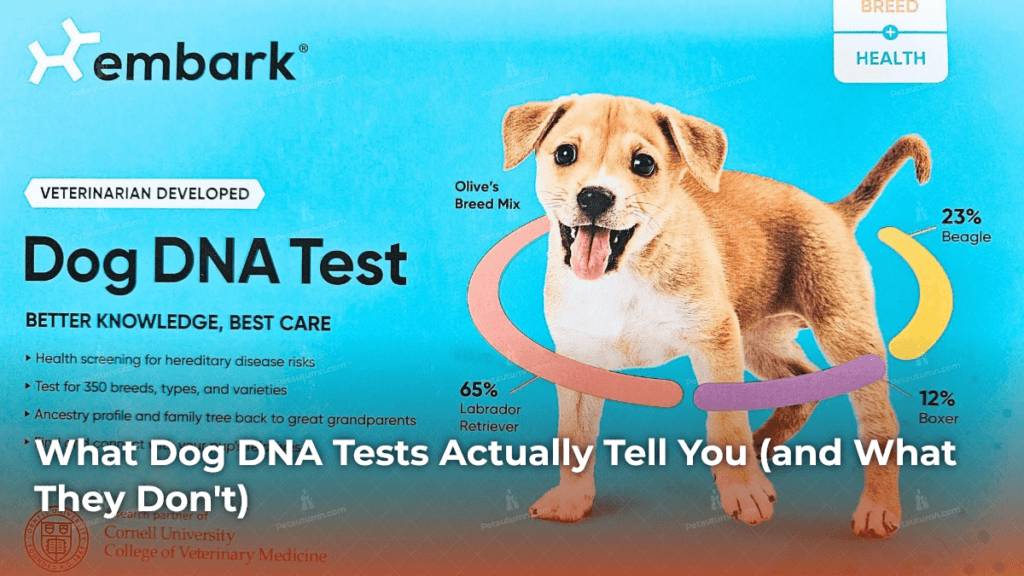
Breed Breakdown vs Health Screening
Most people buy a dog DNA test to find out what their dog is made of. Completely valid. But here’s what a lot of reviews skip over: breed identification and health screening are two separate features, often bundled together in the same kit.
The base tier from both Embark and Wisdom Panel gives you breed percentages. Fun, occasionally shocking, and genuinely satisfying after years of guessing. The premium tier adds genetic health screening, which flags your dog for 200-plus heritable conditions ranging from MDR1 drug sensitivity to exercise-induced collapse. That second layer is what turns a DNA test from a novelty into a tool your veterinarian can actually work with.
Buying the breed-only kit to satisfy curiosity? Totally fine. But if you want results that mean something at your dog’s next checkup, go for the health tier. The price difference is usually $50-$60. Worth it.
Why Rescue Dog Owners Get the Most Value
Rescue dogs arrive with zero medical history. You don’t know what breeds are in the mix, what genetic conditions might be lurking, or which screening protocols your vet should prioritize. That gap is a real problem, especially for mixes predisposed to conditions like hip dysplasia, certain cardiac issues, or degenerative myelopathy.
A DNA test doesn’t fully close that gap. But knowing your dog is 40% Labrador and 30% Chow Chow, for example, tells your vet exactly which breed-specific concerns to monitor. That’s the core argument for rescue owners, and it’s why we ran both kits on Meepo when he was around six years old. The results gave us things to actually talk about at his next appointment, instead of just shrugging at “mixed breed.”
Embark Dog DNA Test Review
Embark is the go-to recommendation on most credible review lists in 2026, and that’s not just brand recognition. The company developed its platform in collaboration with Cornell University College of Veterinary Medicine, one of the most respected veterinary research institutions in the country. That backing shows in the data depth.
Breed Accuracy and Database Size
Embark screens against 350-plus breeds, types, and varieties, including wolf, coyote, dingo, and village dog ancestry. That last category matters more than most owners realize. A significant percentage of rescue dogs in the American South carry feral or village dog ancestry, and tests that don’t account for that end up assigning strange breed combinations to fill the genetic gap.
With 200,000-plus genetic markers, Embark’s breed ID claims 99% ancestry accuracy. For Meepo, both the top-line breeds came back consistent with what we’d suspected for years. Two of the lower-percentage breeds were genuinely surprising. (One of them finally explained the stare.)
Health Conditions Covered
The Breed + Health kit screens for 250-plus genetic health conditions. That includes MDR1 drug sensitivity, which is critical for herding breed mixes and affects how certain medications are metabolized. It also covers exercise-induced collapse, progressive retinal atrophy, and degenerative myelopathy, among many others. Results come back as “at risk,” “carrier,” or “clear,” which is exactly the format most veterinarians prefer for clinical use.
Embark also tests 55-plus physical traits: coat length, eye color, muscling, muzzle shape, body size predictions, and even the appetite gene variant. If you’re already following a proper vet visit schedule for your dog, adding a health DNA report to that routine turns a standard wellness visit into a genuinely proactive conversation.
Price and What You Get
The $159 Breed + Health kit is the right call for most owners. The $99 Breed ID kit is breed percentages only, no health screening. The $349 Premium tier adds a genetic diversity score, a relative-finder with direct messaging (useful for recently adopted rescues who might have siblings in the database), and additional trait depth. Holiday sales typically bring the $159 kit down to $129, so timing your purchase isn’t a bad idea.
Wisdom Panel Dog DNA Test Review
Wisdom Panel has tested over four million dogs. That’s a large reference database, and it shows in the results. The report interface is cleaner and easier to parse than Embark’s, which matters when you’re trying to share findings with a vet who doesn’t have ten minutes to navigate a complex dashboard.
Breed Accuracy and Database Size
Wisdom Panel tests against 350-plus breeds with 1% breed reporting precision, competitive with Embark at the top end. The company claims over 99.9% of dogs in their database have at least one detectable relative, which speaks to the reference panel size. Clicking any breed percentage in the results opens a full breed profile with temperament notes, size ranges, and historical background. That detail is useful if your dog’s mix throws up a breed you’ve never heard of (which happened to us, twice, across both tests).
Results typically come back in two to three weeks. That’s a week faster than Embark in most cases, which isn’t critical but is a nice difference.
Health Conditions Covered
The Essential kit covers 25-plus health conditions and 50-plus trait tests. The Premium kit is a significant step up: 240-plus health conditions, 15 behavioral traits, and the included vet consultation. That consultation is for notable health findings, meaning if something flags in your dog’s results, a vet reviews the data with you rather than leaving you to interpret a complex report alone.
For dogs with potential breed-linked joint issues, knowing your mix ahead of time matters. If a DNA result points toward a predisposition for conditions that commonly affect working or large-breed dogs, that’s directly relevant to supplement planning and joint health monitoring down the line.
Price and What You Get
At $99, the Essential tier is a solid entry point for breed-focused results. At $159, the Premium tier delivers full health screening plus the vet consultation, which is the same price as Embark’s Breed + Health kit. The included consult gives Wisdom Panel a legitimate practical edge at this price point. Worth noting: Wisdom Panel regularly runs sales that bring the Premium kit to $120 or below.
Embark vs Wisdom Panel — Side-by-Side Comparison
Here’s how both tests stack up on the metrics that matter most for most dog owners.
| Feature | Embark Breed + Health ($159) | Wisdom Panel Premium ($159) |
|---|---|---|
| Breeds Tested | 350+ | 350+ |
| Genetic Markers | 200,000+ | Not publicly disclosed |
| Health Conditions | 250+ | 240+ |
| Trait Tests | 55+ | 50+ |
| Results Turnaround | 2-4 weeks | 2-3 weeks |
| Relative Finder | Yes, with direct messaging | Yes, no direct messaging |
| Vet Consultation | No | Yes (Premium tier) |
| Scientific Partnership | Cornell University College of Vet Medicine | Internally developed |
| Report Interface | Detailed, data-heavy | Cleaner, easier to scan |
| Best For | Deepest data, mixed rescues, research-minded owners | Faster results, vet consult, cleaner reporting |
Figures correct as of May 2026. Source: Embark Veterinary, Mars Veterinary.
Which One Is More Accurate?
Embark has the edge on raw accuracy, primarily because of marker count. Testing 200,000-plus genetic markers means fewer ambiguous breed assignments, especially for dogs with complex multi-breed mixes. Wisdom Panel does not publish its equivalent marker count, which is a transparency gap worth noting. For Meepo, both tests agreed on his top two breeds but diverged on the lower-percentage components. In our experience, Embark’s lower-percentage results felt more specific and internally consistent.
Which One Has Better Health Screening?
Embark screens for 250-plus conditions versus Wisdom Panel’s 240-plus at the premium tier. Both cover the critical flags: MDR1 drug sensitivity, exercise-induced collapse, progressive retinal atrophy, and degenerative myelopathy. The practical difference is Embark’s Cornell-backed scientific validation, which has been cited in peer-reviewed canine genetics research. That said, Wisdom Panel’s included vet consultation at the same price point adds real-world value that a raw condition count doesn’t fully capture.
If you’re thinking about how these results interact with your coverage, it’s worth understanding what pet health insurance actually covers for dogs before flagged genetic conditions become a pre-existing exclusion.
Which One Is Worth the Price?
At $159 each, this is a direct feature comparison. Embark wins on data depth and marker count. Wisdom Panel wins on turnaround speed, report readability, and the included vet consultation. Honest answer? You don’t make a wrong choice at this price point. The more useful question is: which features matter most to you and your vet.
What About Ancestry and Basepaws?
Two other names come up in 2026 that are worth a brief look.
Ancestry’s dog DNA test takes the familiar consumer-ancestry approach: clean interface, breed mix results, health screening, and a relative-matching feature that mirrors how their human product works. It’s a solid newer option for owners already comfortable with the Ancestry platform. The breed reference panel is growing, and the reporting design is genuinely user-friendly. That said, Ancestry hasn’t published the same depth of independent validation data as Embark, and the track record in the dog space is still relatively short.
Basepaws is the more interesting story. They built their reputation on cat DNA testing and were acquired by Zoetis, the world’s largest animal health company, in 2022. Their dog DNA kit costs $149 and covers 330-plus breeds and 280-plus health conditions. The technology is different too: Basepaws uses next-generation sequencing instead of the microarray chip method that Embark and Wisdom Panel use, which could eventually produce more granular results. The tradeoff is track record. Embark and Wisdom Panel both have years of published validation data in dogs. Basepaws is still relatively new to canine testing, and independent benchmarks haven’t caught up yet.
Worth watching. Not quite ready to displace the top two, at least not in 2026.
Which Dog DNA Test Should You Actually Buy?
For most dog owners: Embark Breed + Health if you want the most comprehensive genetic picture. Wisdom Panel Premium if you want faster results, a cleaner report, and an included vet consultation for the same $159.
For rescue dog owners specifically, the health kit tier is the right call regardless of which brand you choose. The breed percentage result alone, satisfying as it is, doesn’t give your vet anything actionable. The health screening layer does. And for a dog with unknown history, that information is worth more than the price of the kit.
Run the test. Share the PDF at your next checkup. Ask your vet which flagged conditions, if any, warrant early screening or lifestyle adjustments. That’s the practical sequence. It’s not a diagnosis, it’s not a replacement for staying current on your dog’s preventive care, and it won’t predict every health outcome. But as a starting point for proactive care with a rescue dog? Genuinely worth the investment.
“The information on petautumn.com is for general informational purposes only and does not constitute veterinary advice. Pet health needs vary by breed, age, and individual condition. Always consult a licensed veterinarian before making decisions about your pet’s health, diet, or medical treatment. Pet Autumn is not affiliated with any veterinary organization, pet food manufacturer, or breeder.”
Five years of guessing Meepo’s breed mix, and two DNA tests settled it in under three weeks. The breed results were fun. The health findings are what we actually use now at his vet visits. If you have a rescue with unknown history, that combination of breed data plus health screening is exactly what makes these kits worth the cost. Buy the health tier. Skip the breed-only version unless curiosity is literally the only goal.
Sources
- American Kennel Club (AKC) — breed registry and breed information reference
- Cornell University College of Veterinary Medicine — Embark research partnership and canine genetic validation
Frequently Asked Questions
Have more questions about caring for your dog? Visit Pet Autumn for more guides, reviews, and expert advice.

Dog care writer at petautumn.com. Visual Communication Design graduate (S.Ds) from Universitas Udayana. Covers dog breeds, behavior, training, and gear reviews. Dog dad to Meepo. Based in Austin, Texas.