Last Updated: May 1, 2026
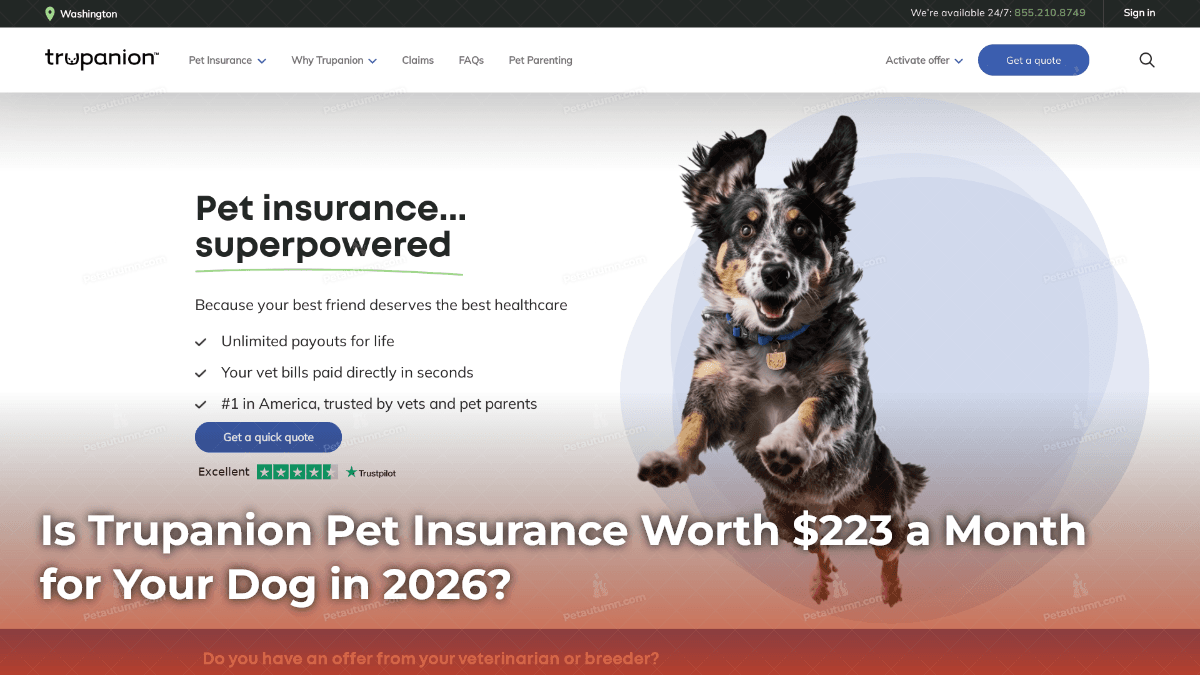
$223 a month. That’s the average American dog owner pays for Trupanion pet insurance in 2026. For a plan with no payout caps and no annual limits, some people see that as a bargain. Others see it and immediately go looking for something cheaper.
Meepo, my rescue pup from Austin, is somewhere around 7 or 8 years old now. He came from the shelter without paperwork, so we’ve always been guessing. At his last checkup, the vet mentioned keeping an eye on his joints as he gets older. That conversation made pet insurance stop being an abstract idea and start being a real budget question. When I dug into Trupanion specifically for petautumn.com, I found a plan that’s genuinely impressive in some ways and genuinely frustrating in others. It deserves more than a star rating.
Here’s what this article covers: what Trupanion actually covers in its base policy, what it costs for your specific dog, how its per-condition deductible structure works (it’s different from every other insurer out there), and whether the monthly price is actually justified for your situation.
Key Takeaways
- Trupanion averages $223/month for dogs and $84/month for cats in 2026, making it one of the most expensive plans in the US market
- The base policy covers accidents and illness at 90% reimbursement with no annual, per-incident, or lifetime payout caps
- A per-condition lifetime deductible, rather than an annual one, is Trupanion’s biggest structural advantage for dogs with chronic conditions
- VetDirect Pay lets Trupanion pay your vet directly at checkout at over 10,000 participating clinics, eliminating the standard claims process entirely
- No wellness coverage, no multi-pet discount, and premiums that increase with age are the three biggest drawbacks worth knowing before you enroll
What Does Trupanion Actually Cover in 2026?

What’s Included in the Base Policy
Trupanion sells one base plan: accident and illness coverage at 90% reimbursement with no annual, per-incident, or lifetime payout caps. That last part is what separates it from most competitors. If your dog develops cancer or needs emergency orthopedic surgery that runs $30,000, Trupanion pays 90% of eligible costs. No ceiling. Ever.
The base policy covers accidents and injuries, illnesses, chronic conditions, prescription medications (some), dental illness and injury (provided your pet has had at least one dental exam on file per year), breed-specific hereditary conditions, and diagnostic testing including bloodwork, imaging, and lab fees. Coverage kicks in after a 5-day waiting period for accidents and 30 days for illness.
| Coverage Category | Included? | Notes |
|---|---|---|
| Accidents and injuries | ✅ Yes | After 5-day waiting period |
| Illness and disease | ✅ Yes | After 30-day waiting period |
| Chronic conditions | ✅ Yes | Per-condition lifetime deductible applies |
| Prescription medications | ✅ Some | Check policy documentation for specific exclusions |
| Dental illness and injury | ✅ Yes | Requires annual dental exam on record |
| Hereditary and breed-specific conditions | ✅ Yes | No separate waiting period unlike some competitors |
| Wellness and preventive care | ❌ No | Vaccines, annual exams, flea/tick prevention excluded |
| Exam fees | ❌ No | Vet exam fees not covered in most situations |
| Pre-existing conditions | ❌ No | Standard exclusion across all pet insurers |
| Spay and neuter | ❌ No | Elective procedures excluded |
Source: Trupanion Pet Insurance, verified May 2026.
Add-Ons Worth Considering
Three optional riders expand what Trupanion covers beyond the base plan.
The Recovery and Complementary Care Rider adds physical therapy, hydrotherapy, acupuncture, chiropractic care, and behavioral therapy. For a senior dog with hip dysplasia or post-surgery rehab needs, this one earns its keep. It can be added within the first 30 days of enrollment or removed at any time.
The Breeding Rider covers select care related to intentional breeding, including pregnancy complications and emergency C-sections. If you’re not a breeder, skip it.
The Pet Owner Assistance Package is the oddest of the three, but it covers some real worst-case situations: up to $500 toward lost/stolen pet advertising, up to $500 for licensed boarding if you’re hospitalized four or more days, up to $100 for burial or cremation expenses, and up to $1,000 for emergency vet care during travel. Not expensive to add, and those scenarios aren’t as unlikely as they sound.
What Trupanion Flat-Out Won’t Cover
Here’s where disappointment shows up in reviews. Trupanion covers nothing in the preventive or routine category: no annual wellness exams, no vaccinations, no dental cleanings, no spay or neuter, and no flea and tick prevention. There is no wellness add-on available at all, unlike Embrace or Spot, which offer optional preventive care packages.
Pre-existing conditions are excluded across the board. What makes Trupanion more strict than some competitors is how it groups related conditions. A new health issue can get denied if Trupanion categorizes it as related to something your dog had before enrollment. This comes up repeatedly in Trustpilot reviews and Reddit threads. It’s the most common frustration among long-term members. Worth knowing upfront.
How Much Does Trupanion Cost Per Month – For Real?
Average Monthly Cost by Breed and Age
Trupanion doesn’t publish a flat rate sheet. Premiums are calculated individually based on your dog’s breed, age, and zip code, which is why the national averages in 2026 reviews vary slightly depending on the sample. The table below uses verified data from multiple independent sources.
| Dog Type / Age | Estimated Monthly Cost | Context |
|---|---|---|
| Golden Retriever, age 2 | ~$65/month | Mid-US region, 90% reimbursement, unlimited limit |
| Golden Retriever, age 8 | ~$120/month | Same plan, same dog, six years of age increases |
| Golden Retriever, age 12 | ~$180/month | Senior tier, no rate lock applied |
| Medium mixed breed (national avg) | $223/month | Average across all US regions, ages, and breeds |
| Any dog, Arkansas (lowest state) | From $126/month | Lowest-cost state in 2026 MoneyGeek analysis |
| Any dog, California (highest state) | Up to $330/month | Highest-cost state in 2026 MoneyGeek analysis |
| Domestic shorthair cat (national avg) | $84/month | Cat coverage is significantly cheaper than dogs |
Sources: MoneyGeek, Zogby, and US News independent analyses, 2026. All estimates based on 90% reimbursement and unlimited annual limit.
The California-to-Arkansas gap is not a rounding error. A dog in San Francisco can cost more than double what the same dog in Little Rock costs on the exact same plan. Trupanion prices on actual regional veterinary costs, not a national blended rate. Always get a quote with your real zip code before comparing it to any published average.
Why Your Premium Goes Up Every Year (And Won’t Stop)
Trupanion operates as a monthly subscription with no annual contracts, no cancellation fees, and no rate lock. That’s the honest trade-off for the flexibility. Premiums increase continuously as your dog ages, because older dogs cost more to treat. There’s no ceiling on those increases.
The Golden Retriever example above is real data: $65/month at age 2 can reach $180/month by age 12. Over a 12-year period, you’re looking at a total premium spend somewhere between $15,000 and $30,000 depending on your location, before a single claim is paid. If you want to understand how this math compares to going uninsured, the breakdown in our vet bill cost article puts real numbers behind the risk.
Most dog owners are also surprised by one other thing: if you cancel your policy and come back later, you’re treated as a new customer. The clock restarts on waiting periods, and any conditions your dog developed in the meantime become pre-existing. Canceling is easy. Getting back in is harder.
How the Per-Condition Deductible Actually Saves You Money Long-Term
This is the structural feature that most people don’t fully understand until they’re already in year three of a policy. And it’s the thing that keeps Trupanion worth it for owners with dogs that develop chronic conditions.
With a standard annual deductible model (used by most competitors), you pay your deductible every single policy year for every condition. If your dog has hip dysplasia and gets treated for five years, you pay $500 in deductibles five times. That’s $2,500 in deductibles before Trupanion-style coverage ever starts working for you.
With Trupanion’s per-condition lifetime deductible, you pay that $500 once for hip dysplasia. Once it’s met, all future eligible costs for that condition are covered at 90% for the rest of your dog’s life. Same logic applies to diabetes, recurring allergies, urinary issues, and joint disease. The deductible range runs from $0 to $1,000, and you choose your amount at enrollment. Lower deductible means higher monthly premium. The optimal combination depends on your dog’s actual health history.
Before you dismiss this as marketing language, read what most dog owners get wrong about pet health insurance in 2026 first. The deductible model difference is one of the most commonly misunderstood factors when comparing plans side by side.
VetDirect Pay – Trupanion’s Biggest Selling Point, Explained
How It Works at the Vet Clinic
This is the feature that genuinely separates Trupanion from every other pet insurer in the US. No other company does this. When your vet’s clinic is in Trupanion’s VetDirect Pay network, the insurance claim is processed at checkout. Trupanion pays the hospital directly. You walk out paying only your 10% portion.
No paperwork. No waiting. No uploading invoices to a portal at midnight while your dog is still groggy from anesthesia.
For vets outside the network, Trupanion reports that 70% of claims submitted through their online portal are paid within 24 hours. That’s still faster than most competitors. Worth noting: the Trupanion mobile app is no longer available for download on iOS or Android as of 2026. All online claims go through the web portal exclusively, which isn’t ideal for anyone who preferred the app.
If you’ve dealt with the standard pet insurance process, you know what a difference this is. Submit invoice, wait 5 to 14 business days, sometimes receive a partial denial, then appeal. VetDirect Pay eliminates most of that entirely for participating clinics.
Which Vets Actually Accept It
Over 10,000 veterinary hospitals in the US have Trupanion’s direct payment software installed. That sounds substantial, and it is, but it still represents a minority of all licensed vet practices nationwide. Not every clinic has adopted it, and your regular vet may or may not be in the network.
Check two things before you commit: your primary vet, and your nearest 24-hour emergency clinic. Emergency clinics are where the biggest bills tend to happen. If neither participates, you lose Trupanion’s most meaningful differentiator and you’re left with a premium-priced plan that reimburses like any other insurer. The VetDirect Pay locator is on Trupanion’s website and searchable by zip code. Check it first. Seriously.
Our dog vet visit schedule guide covers what routine and preventive care actually costs per year at each life stage, which helps put the insurance decision in proper financial context.
Trupanion Pros and Cons – The Honest Breakdown
| Pros | Cons |
|---|---|
| No annual, per-incident, or lifetime payout caps | One of the highest average monthly premiums in the US market |
| Per-condition lifetime deductible is significantly better for chronic illness than annual models | No wellness or preventive care coverage, and no wellness add-on option |
| VetDirect Pay: vet paid at checkout, no reimbursement wait | Premiums increase continuously with age, no rate lock ever |
| Simple structure: one plan, one reimbursement rate, no complicated benefit schedules | No multi-pet discount, even for households with five pets |
| A+ BBB rating, 4.2/5 Trustpilot, 99% member renewal rate | Mobile app discontinued in 2026; claims via web portal only |
| Available in all 50 states, covers all dog and cat breeds | Exam fees excluded even during emergency visits |
| Over $3.5 billion in claims paid since founding, publicly traded (NASDAQ: TRUP) | Strict condition grouping policy can lead to unexpected claim denials |
Honestly? The no-payout-cap feature is what keeps people on Trupanion despite the cost. Most cheaper alternatives cap annual payouts somewhere between $5,000 and $15,000. If your dog develops lymphoma at age 9 and treatment runs $40,000, you will be very glad you weren’t with the $29/month plan. That scenario is less rare than people think.
Who Should Get Trupanion, and Who Probably Shouldn’t
Trupanion works best for a specific type of dog owner. You’re a strong candidate if your dog is a breed with documented risk for expensive conditions (Golden Retrievers, Labradors, German Shepherds, French Bulldogs, and Great Danes all qualify), you plan to keep the same insurer for your dog’s entire life, your regular vet and emergency clinic already accept VetDirect Pay, and you genuinely want unlimited coverage for worst-case medical events without ever filing a reimbursement claim manually.
You’re probably better off looking elsewhere if you want wellness and preventive care included in your plan, you have two or more pets (the lack of a multi-pet discount stings when you’re paying $223 per dog), your monthly budget can’t absorb premium increases as your dog gets older, or your vet isn’t part of the VetDirect Pay network. Without that feature, Trupanion is an expensive plan that works roughly like every other expensive plan.
If you have cats too, the coverage equation is a bit different. Our analysis of the best pet insurance plans for cats in 2026 covers the comparison in more detail.
“The information on petautumn.com is for general informational purposes only and does not constitute veterinary advice. Pet health needs vary by breed, age, and individual condition. Always consult a licensed veterinarian before making decisions about your pet’s health, diet, or medical treatment. Pet Autumn is not affiliated with any veterinary organization, pet food manufacturer, or breeder.”
Trupanion is not the cheapest pet insurance you’ll find. Not close. But it’s built around a different philosophy than most plans: cover everything unexpected, pay fast, and never cap what it will pay out. For the right owner and the right dog, that philosophy justifies the premium. For everyone else, it’s an expensive plan with real gaps.
The questions that actually matter before you enroll: Does your vet accept VetDirect Pay? Does your dog have a breed profile that makes lifetime deductible coverage valuable? And can your budget absorb monthly premium increases over a 10 or 12-year lifespan? If yes across the board, Trupanion is hard to argue against.
Get a real quote using your actual zip code, check the VetDirect Pay locator for your vet, then compare it against one direct competitor. That 20 minutes of research will tell you more than any review article can.
Sources

Dog care writer at petautumn.com. Visual Communication Design graduate (S.Ds) from Universitas Udayana. Covers dog breeds, behavior, training, and gear reviews. Dog dad to Meepo. Based in Austin, Texas.