Last Updated: April 30
Your outdoor cat is not living the same life as the cat napping on your neighbor’s couch for 18 hours a day. She’s climbing, hunting, patrolling, sprinting, and covering ground that adds up fast. That changes everything about what she needs to eat — and how much.
Here’s the thing most cat food labels won’t tell you: outdoor cats can burn 20–40% more calories than indoor cats of the same weight. Feed them the same food in the same portion and you’re probably underfeeding them. Over time, that shows up as muscle loss, dull coat, low energy, and a cat that never seems satisfied. At petautumn.com, we hear this complaint more than almost any other from outdoor cat owners.
This guide covers exactly what outdoor cats need nutritionally, what to look for on the label, and the best cat foods we’ve found that actually hold up for active, roaming, outdoor life in 2026.
Key Takeaways
- Outdoor cats need significantly more calories and protein than indoor cats due to higher daily activity
- Look for a named animal protein (chicken, salmon, turkey) as the very first ingredient — not “meat meal” or “by-product”
- Taurine is non-negotiable; cats cannot produce it on their own and must get it from food
- Wet food isn’t just a preference — for outdoor cats, it helps maintain hydration that activity demands
- A 10-pound active outdoor cat may need 280–350+ kcal per day, compared to 200–250 for a sedentary indoor cat
Why Outdoor Cats Need Different Food Than Indoor Cats
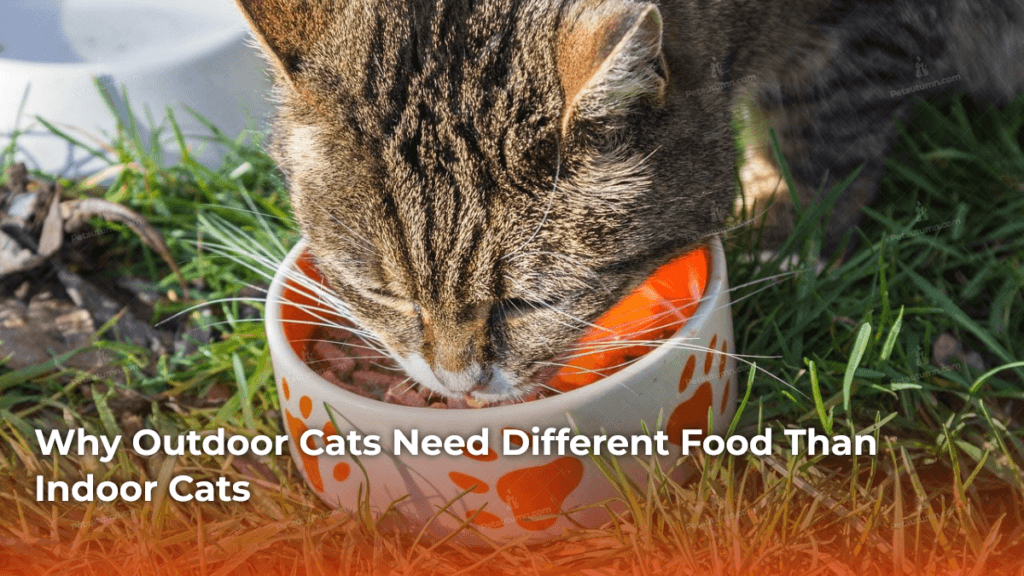
This isn’t just about calories. The lifestyle gap between an indoor and outdoor cat is actually enormous — and the nutritional difference follows.
Higher Calorie Burn From Daily Activity
A neutered indoor cat who sleeps most of the day needs roughly 200–250 calories to maintain a healthy 10-pound body. Put that same cat outdoors with a territory to patrol? Expect calorie needs to climb to 280–350 kcal/day or higher, depending on temperature, terrain, and season. Cold winters push that even further — outdoor cats in northern climates burn additional calories just staying warm.
An indoor cat who sleeps most of the day can need 30–40% fewer calories than an outdoor cat of the same weight. That’s not a small gap. It means a food formulated for sedentary indoor cats isn’t keeping up with what your outdoor cat is actually spending.
Beyond calories, outdoor cats also put more wear on their muscles and joints. A food that’s adequate for a house cat can be genuinely insufficient for one that covers a quarter-mile territory every evening.
Protein and Fat Ratios That Matter
Cats are obligate carnivores. That’s not a lifestyle choice — it’s biology. Unlike dogs, cats cannot efficiently convert plant protein into the amino acids they need. Their bodies are built to derive energy primarily from protein and fat, not carbohydrates.
Taurine is one of the most important nutrients in a cat’s diet, and since cats can’t synthesize it themselves, they must get 100% of their daily requirement from food. Omega-6 fatty acids are also critical for coat and skin health. For an outdoor cat dealing with sun, wind, and seasonal temperature swings, coat quality isn’t cosmetic — it’s protective.
A good outdoor cat food should have at minimum 40% protein and 18% fat on a dry matter basis. Anything below 35% protein is worth questioning for an active, roaming cat.
What to Look for on the Label Before You Buy
Knowing the difference between a quality label and marketing noise saves a lot of wasted money — and keeps your cat healthier long-term.
Named Protein Sources vs. Meat Meal
The first ingredient tells you the most about what you’re actually feeding. “Chicken” means whole chicken. “Chicken meal” is concentrated dried chicken — which isn’t inherently bad, but “by-product meal” is where the quality gets murky. “Animal digest” is a red flag.
Look for foods where the first two or three ingredients are named animal proteins: chicken, turkey, salmon, tuna. If the first ingredient is a grain, a vegetable, or a vague term like “poultry,” that’s not a food designed around what a cat actually needs. Worth noting — an AAFCO nutritional adequacy statement on the label confirms the food meets minimum nutritional standards, but it’s a floor, not a ceiling. Outdoor cats deserve better than minimum.
If your cat has a history of food sensitivities, it’s worth reading about cat food allergies before committing to a new formula — some proteins trigger reactions even in otherwise healthy cats.
Taurine, Omega-3s, and Joint Support
Every cat food worth buying should list taurine explicitly. Omega-3 fatty acids (EPA and DHA) are a bonus — they support joint health, skin condition, and cognitive function, which matters more as your cat gets older. For senior outdoor cats especially, look for formulas that include glucosamine and chondroitin.
The ASPCA notes that cats require specific nutrients that they cannot synthesize on their own, including taurine, arachidonic acid, and preformed vitamin A — all of which must come directly from animal sources in the diet.
The Best Cat Foods for Outdoor Cats in 2026
These picks are based on ingredient quality, protein-to-fat ratios, AAFCO compliance, veterinary recommendations, and real-world usability for outdoor feeding scenarios.
Best Overall — High Protein Wet Formula
Purina Pro Plan is consistently one of the most recommended brands by veterinarians — and it shows on the label. Pro Plan’s dry recipes carry around 40% protein and 18% fat on a dry matter basis, and the wet range uses real meat as the primary protein source. For an outdoor cat that needs hydration as much as calories, the pâté format delivers both.
The moisture content helps compensate for the fact that outdoor cats often don’t drink as much water as they should — especially in hot weather. One honest note: a few varieties do include meat by-products as secondary ingredients, which isn’t a dealbreaker but is worth knowing if you’re particular about ingredient sourcing.
Best Dry Food for Outdoor Cats
If you want the highest protein dry food on this list — 41% crude protein, 21% fat, 505 calories per cup — Instinct Original delivers. Each piece of kibble is coated with freeze-dried raw for added nutrition and taste, and the formula contains 81% real animal ingredients with no grain, potato, corn, wheat, soy, by-product meal, artificial colors, or preservatives.
Real talk: this is one of the few kibbles that owners of working farm cats and semi-feral outdoor cats consistently recommend. The calorie density means outdoor cats can eat less volume and still hit their daily energy needs. The transition can be bumpy for some cats (slower is better — 7 to 10 days), but most settle in fine.
Lina, who has never met a food she couldn’t find fault with, took to this within three days. Luna needed a week. (Ask us how we know the difference between a cat who’s skeptical and a cat who’s just dramatic about it.) For cats that need high-protein nutrition and actually spend time outdoors, this is our dry food pick.
Best Budget Option That Still Delivers
Purina ONE doesn’t get the hype it deserves. At roughly $2.50–$3.25 per pound, it delivers 42% protein on a dry matter basis — genuinely competitive with brands charging twice the price. Purina ONE is a high protein option combined with a fiber blend that helps cats maintain a healthy weight, plus four antioxidant sources to support the immune system, and it’s made without artificial flavors or preservatives.
Does it contain grain? Yes. Is that automatically a problem? For most healthy outdoor cats with no documented sensitivities, no. The grain debate in cat nutrition is messier than marketing suggests. If your cat isn’t showing signs of food allergies or sensitivities, Purina ONE is a solid, trustworthy everyday option that won’t drain your wallet.
Best for Senior Outdoor Cats
A senior cat that still goes outdoors — and plenty do — needs a food that supports muscle maintenance and organ health, not just maintenance-level calories. Hill’s Science Diet Adult 7+ has precisely balanced nutrition to support kidney and vital organ health, features high-quality protein for building lean muscles, and includes clinically proven antioxidants (vitamins C+E) for a healthy immune system.
The wet format is especially important for older cats. Senior cats are at higher risk of dehydration and kidney stress, and the moisture in wet food helps significantly. If your outdoor cat is over seven and you’re still feeding them an adult maintenance formula designed for a five-year-old, that’s worth revisiting with your vet.
How Much Should an Outdoor Cat Eat Per Day?
This is where most outdoor cat owners get it wrong. The bag says one thing. Your cat burns something else entirely.
Feeding Schedule for Free-Roaming Cats
A general starting point: an active, outdoor, 10-pound adult cat needs approximately 280–350 kcal per day, compared to 200–250 for an indoor cat of the same size. That gap grows in winter and for intact (unspayed/unneutered) cats.
The table below gives a practical feeding reference based on weight and lifestyle for adult outdoor cats. Use it as a starting point — not a hard rule — and adjust based on your cat’s body condition score.
| Cat Weight | Estimated Daily kcal (Outdoor Active) | Approx. Dry Food (High Protein) | Approx. Wet Food (Pâté) |
|---|---|---|---|
| 7 lbs | 200–260 kcal | ⅓–½ cup | 2–2.5 cans (3 oz) |
| 10 lbs | 280–350 kcal | ½–⅔ cup | 2.5–3.5 cans (3 oz) |
| 12 lbs | 325–400 kcal | ⅔–¾ cup | 3–4 cans (3 oz) |
| 15 lbs | 390–480 kcal | ¾–1 cup | 4–5 cans (3 oz) |
Note: Figures based on a moderately active outdoor adult cat using foods around 400–505 kcal/cup dry or ~100–120 kcal per 3-oz wet can. Always verify calorie density on the specific food label. Figures correct as of April 2026.
Free-roaming cats do best with two scheduled meals per day — morning and evening — rather than free-feeding. It gives you a daily check-in on appetite (a missed meal is often the first sign something’s off) and prevents the food from sitting out and attracting wildlife.
Signs Your Outdoor Cat Is Under- or Over-Eating
The body condition score (BCS) is the most reliable check. You should be able to feel your cat’s ribs with light pressure but not see them clearly. A visible spine, prominent hip bones, or loose skin folds around the abdomen signal underfeeding. A rounder belly, difficulty jumping, and ribs buried under a fat layer point the other direction.
Under-eating signs specific to outdoor cats include sudden drop in patrol/roaming behavior, rough or dull coat, muscle wasting around the shoulders and hips, and unexpected weight loss over two to four weeks. Any of those should go to a vet — not a food change alone.
Outdoor Cat Food — Wet vs. Dry vs. Raw
The short answer? A combination of wet and dry usually wins for outdoor cats.
Dry food is calorie-dense, doesn’t spoil in the bowl, and works well for morning feeding when your cat is heading out. The downside is hydration — dry food has around 10% moisture, which isn’t nearly enough on its own for a cat burning energy outdoors all day.
Wet food delivers hydration alongside protein and fat, which is why most vets lean toward it for outdoor cats, especially in warmer months. The trade-off is spoilage — don’t leave wet food out in summer heat for more than 30 minutes. Evening feeding with wet food works well as a complement to a dry morning meal.
Raw diets come up often in this conversation. The American Veterinary Medical Association (AVMA) discourages raw feeding for cats due to the risk of bacterial contamination — pathogens like Salmonella and Listeria — and the difficulty of ensuring a nutritionally complete formulation. For outdoor cats who already have a higher exposure to environmental pathogens, that risk compounds. Honestly? The appeal makes sense, but the safety case for raw isn’t strong enough to recommend it over well-formulated wet or dry food.
For most outdoor cats, the practical winner is this: high-quality dry food in the morning, a can of high-protein wet food in the evening. Simple, balanced, and it covers hydration and calorie needs across the day.
If you’re also weighing overall value across different vet-approved cat food brands before committing to a formula, that breakdown is worth reading before you decide.
“The information on petautumn.com is for general informational purposes only and does not constitute veterinary advice. Pet health needs vary by breed, age, and individual condition. Always consult a licensed veterinarian before making decisions about your pet’s health, diet, or medical treatment. Pet Autumn is not affiliated with any veterinary organization, pet food manufacturer, or breeder.”
Every cat is different — what works for one may not work for another. A vet can help determine the best diet for your outdoor cat based on their specific weight, activity level, and health history.
Feeding an outdoor cat well isn’t complicated — but it does require paying attention to a few things that most bag labels quietly ignore. More activity means more calories, more protein, and more hydration. Start with a named animal protein at the top of the ingredient list, verify your AAFCO statement, and pick a format (wet, dry, or both) that fits your feeding setup and your cat’s lifestyle.
The simplest next step: weigh your cat, check their body condition score, and compare their current daily calories against what they’re actually burning outdoors. If the numbers don’t add up — the food switch might be overdue.
And don’t forget: outdoor cats face more health risks than indoor ones, from parasites to injuries to environmental exposures. Pairing the right nutrition with regular vet checkups and solid cat health insurance is the full picture. Your cat is putting a lot of miles on that body every day. Feed accordingly.
Sources:
- American Veterinary Medical Association (AVMA) — Raw Pet Foods
- ASPCA — Cat Nutrition
- Association of American Feed Control Officials (AAFCO) — Cat Food Nutrient Profiles
Frequently Asked Questions
More cat care guides, food reviews, and vet-backed tips — visit petautumn.com

Cat care writer at petautumn.com. English Literature graduate (S.S) from Universitas Udayana. Covers cat breeds, behavior, nutrition, grooming, and health. Cat mom to Luna and Lina. Based in Austin, Texas.