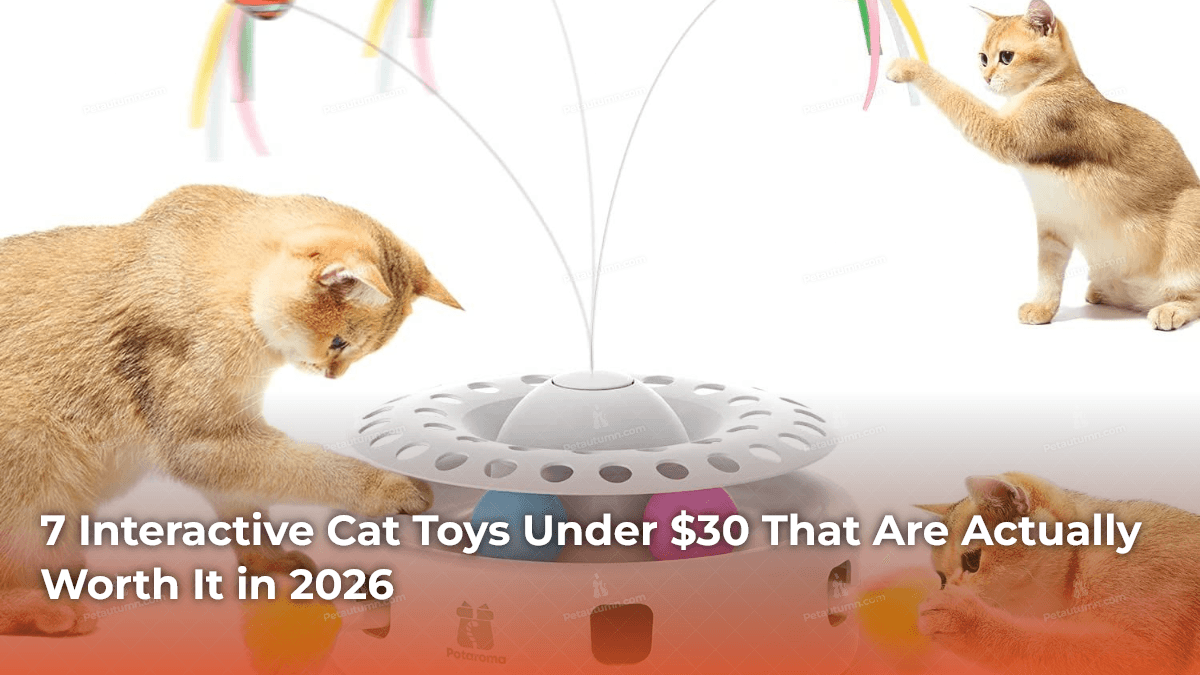
Last Updated: May 3, 2026
Here is a scenario that probably sounds familiar. You spot a sleek new cat toy online – the one with the USB charging port, the five-star reviews from three hundred verified cat parents, the product video where the cat looks absolutely mesmerized. You buy it. It arrives. Your cat sniffs it for four seconds, then walks away to investigate a crumpled grocery receipt on the kitchen counter.
Lina did this to me in February. The toy cost $38. She gave it considerably less attention than she gives my alarm clock, which she hates and makes very loudly known every morning. Luna offered it a long, slow blink from across the room – but honestly, I still cannot tell if that was approval or pity.
Here is the thing: expensive does not equal engaging. At petautumn.com, we have tested a range of interactive cat toys at different price points, and the seven picks below all land under $30. All of them have actually held Luna and Lina’s attention past the first session – and a few of them past the first month.
Key Takeaways:
- Budget interactive cat toys can match premium options when they target natural prey instincts
- The $10-$20 range is the sweet spot for value – the best picks live here
- Randomized, unpredictable motion holds a cat’s attention far longer than looping patterns
- Rotating toys every 3-4 days keeps novelty high, even with great picks
- Always supervise cats during the first few sessions with any electronic or automated toy
Can Budget Cat Toys Actually Be Good?
Short answer: yes. Very much yes.
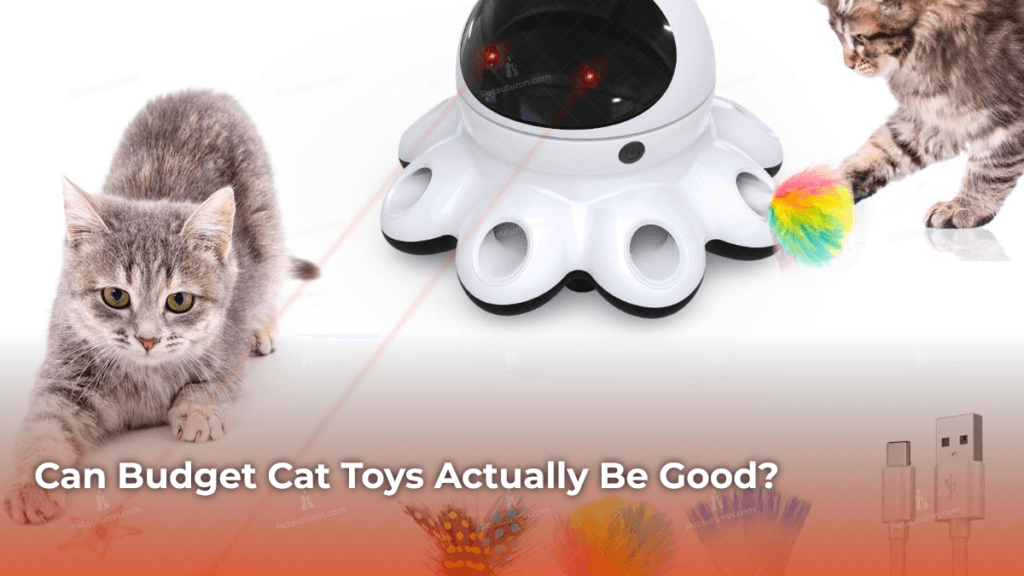
Cats do not respond to price tags. They respond to movement, texture, sound, and surprise – anything that mimics the behavior of real prey. A $7 feather wand operated at the right speed and angle can outperform a $65 automated gadget that loops the same predictable pattern every 30 seconds. This is not a controversial opinion – it is how feline play behavior actually works, and researchers at the Cornell Feline Health Center have documented extensively how important unpredictability is to sustained cat engagement.
That said, budget toys do fail in predictable ways. The motor burns out after two weeks. The feather attachment falls off on day three. The rattle inside goes silent before the end of the first play session. So the real question was never “is this toy affordable?” – it was “is this affordable toy built to survive regular use?”
Every pick on this list cleared both tests. And if your cat seems checked out, restless, or difficult to engage even with toys they used to like, it is worth understanding what a cat behaviorist looks for – understimulation shows up in more behaviors than most owners expect.
What We Looked for When Testing Under-$30 Picks
Not just “does the cat like it on day one.” That part is easy. The harder test is day seven, day fourteen.
Engagement quality, not just initial curiosity. Every cat investigates something new. We were looking for toys that cats returned to on their own after the novelty faded – not just sniffed once and forgot.
Motion unpredictability. Looping or repetitive movement stops resembling prey almost immediately. The toys that made this list all have some element of randomness – variable speed, irregular direction changes, or touch-activated response.
Safety under real-world conditions. No small detachable parts. No strings or cords long enough to pose a tangle or swallowing risk. No materials that splinter or fragment during enthusiastic chewing. For Lina, who treats every toy like a wrestling opponent, durability is a safety issue just as much as a quality issue.
Honest value. A $9 toy that lasts six months beats a $25 toy that falls apart in three weeks every single time.
The 7 Best Interactive Cat Toys Under $30 in 2026
Best Under $10
Two picks in this tier. Both well under ten dollars, both earn their place in any cat’s regular rotation.
The Hot Pursuit’s strongest trick is that your cat cannot see the source of the movement – only the bump and shift under the fabric cover. That uncertainty keeps engagement unusually high even in repeat sessions. The two speed settings help: low for older or less mobile cats, high for cats who need something that really fights back. Battery life is approximately one hour per session, so turning it off between play sessions extends that significantly.
No electronics, no charging cable, no motor to burn out. You drag it across the floor, dip it behind the couch cushion, make it flutter toward the ceiling – and your cat’s brain does the rest. Honest opinion: this is still the toy I reach for most when Luna is restless and I want something that works immediately. The feathers do shed with regular use, so plan to replace the attachment every two to three months.
Best Under $20
The sweet spot. Three picks here, each filling a completely different enrichment need.
The Tower of Tracks solves a specific, very real problem: balls disappear under furniture. Here, six colorful balls are locked into three stacked circular tracks – they spin and roll, but they are not going anywhere. Luna will sit at the middle track and bat at it for 20 solid minutes without any encouragement. It works equally well in single-cat and multi-cat households, which makes it one of the more versatile picks on this list. Ranked the best bang-for-buck pick by multiple independent reviews in early 2026.
The Catit circuit rewards the kind of cat who would rather stalk and track than leap and pounce. The partially covered track creates a visibility game – the ball is visible but not reachable. Reconfiguring the track layout every few weeks (the pieces click together in different arrangements) resets novelty without buying anything new. That modular angle makes this one of the better long-term value picks at this price point.
Most interactive toys focus on the chase. The Potaroma Fish focuses on the catch – the moment your cat grabs something and gets to actually wrestle with it. The motion sensor activates when the cat bats or grabs the fish, making it flop and wiggle, then rest, then respond again on the next touch. Lina is genuinely obsessed with this one in a way I find mildly concerning. The catnip pouch inside the fish adds an extra motivation layer for cats who are catnip-responsive, which not all cats are (roughly 50% respond strongly).
Best Under $30
Upper end of the budget. These two are as close to a premium feel as you will get without crossing thirty dollars.
The Ambush earns its spot through genuine unpredictability. The feather pops out from one of six holes, randomly, at variable intervals – your cat genuinely cannot predict which hole or when. The 8-minute auto-shutoff protects battery life and prevents overstimulation. Fair warning: this toy is noisy. Cats who are sensitive to sound will need a slow introduction – start with the toy off, let them investigate the base, then introduce motion in short sessions. It comes with one replacement feather, which is useful because the feather is always the first thing to go.
The Digger is the only puzzle-style pick on this list, and it earns its spot because the enrichment type is entirely different from everything else here. Instead of chasing motion, your cat uses their paws to retrieve treats or kibble from five varied-height tubes. It rewards patience and problem-solving – two things cats have more of than most owners give them credit for. Load it with regular kibble to make it a meal enrichment tool, or use high-value treats for extra motivation. No noise. No batteries. Completely silent – which matters in apartments or households where the sound of an electronic motor at 11 PM is not appreciated.
What to Skip – Cheap Toys That Are Just Bad
Not every affordable cat toy is worth buying. A few patterns to watch for.
Long strings and ribbon-based toys. Any toy where a length of string or ribbon is the main attraction poses a swallowing risk if a cat chews through it. These are supervised-play-only items – store them out of reach when you are not actively holding them.
Laser-only toys. Lasers create the hunt but never allow the catch, and some cats develop visible frustration behaviors as a result – restlessness, redirected aggression, repetitive circling. If you use a laser, always end the session by redirecting to a physical toy your cat can actually grab.
Jingle bell attachments on cheap plush toys. Small bells inside inexpensive plush toys can be chewed off and swallowed. Inspect any new plush toy before handing it over unsupervised.
Toys sold only on price. A bag of 50 plastic balls from a non-pet-specific brand is not enrichment – it is a pile of plastic that will eventually create a choking hazard as the outer coating chips. Cheap materials, thin fabric, and weak electronic motors fail fast, and they often fail in ways that create safety concerns. The ASPCA recommends checking all cat toys for small detachable pieces before introducing them, regardless of price.
How to Get the Most Out of Budget Interactive Toys
Rotation is the single most underrated strategy in cat enrichment. Keeping all toys visible and accessible at all times means none of them are exciting anymore. Put two or three away for a week, then swap them back in. The reaction to a “new” toy they have actually owned for months is always worth watching.
Play timing matters. Cats are naturally most active at dawn and dusk – these are peak hunt windows. A ten-minute play session at 7 PM will get more genuine engagement than the same session at 2 PM. If your cat is prone to kneading on you in the evenings, that is often a signal they are in a receptive mood for interactive activity.
Always end sessions with something physical your cat can catch and hold. Toss a small stuffed toy, the Potaroma Fish, or any plush kicker toward them. Letting the session end without a “kill” leaves the hunt sequence incomplete, and some cats find that genuinely frustrating in ways that show up later as restlessness. A few seconds of wrestling with a plush toy costs nothing and makes the whole play session feel resolved. If you are also rethinking how your indoor cat is being fed, most indoor cat owners get the nutrition side wrong too – enrichment covers more than just physical play.
“The information on petautumn.com is for general informational purposes only and does not constitute veterinary advice. Pet health needs vary by breed, age, and individual condition. Always consult a licensed veterinarian before making decisions about your pet’s health, diet, or medical treatment. Pet Autumn is not affiliated with any veterinary organization, pet food manufacturer, or breeder.”
You do not need to spend $60 on a cat toy to keep your cat engaged. You need something that fits how your cat actually plays, built well enough to survive regular use, and rotated often enough to stay interesting.
Start with one pick from the under-$20 tier – the Tower of Tracks if your cat is a solo batter, the Potaroma Fish if they are a wrestler, the Catit Circuit if they like tracking movement with their paws. Add the PetFusion Ambush if you want something automated and hands-free. That combination covers all the enrichment bases – mental and physical – without going anywhere near triple-digit spending.
And if nothing on this list seems to land with your cat? That is useful data, not a failure. It means your cat has a specific play profile worth paying attention to – and there is almost always a toy that fits it.
Sources:
- Cornell Feline Health Center – Feline behavior, enrichment, and play guidelines
- ASPCA Cat Care – General cat safety and toy guidelines
Frequently Asked Questions

Cat care writer at petautumn.com. English Literature graduate (S.S) from Universitas Udayana. Covers cat breeds, behavior, nutrition, grooming, and health. Cat mom to Luna and Lina. Based in Austin, Texas.