Last Updated: May 1, 2026
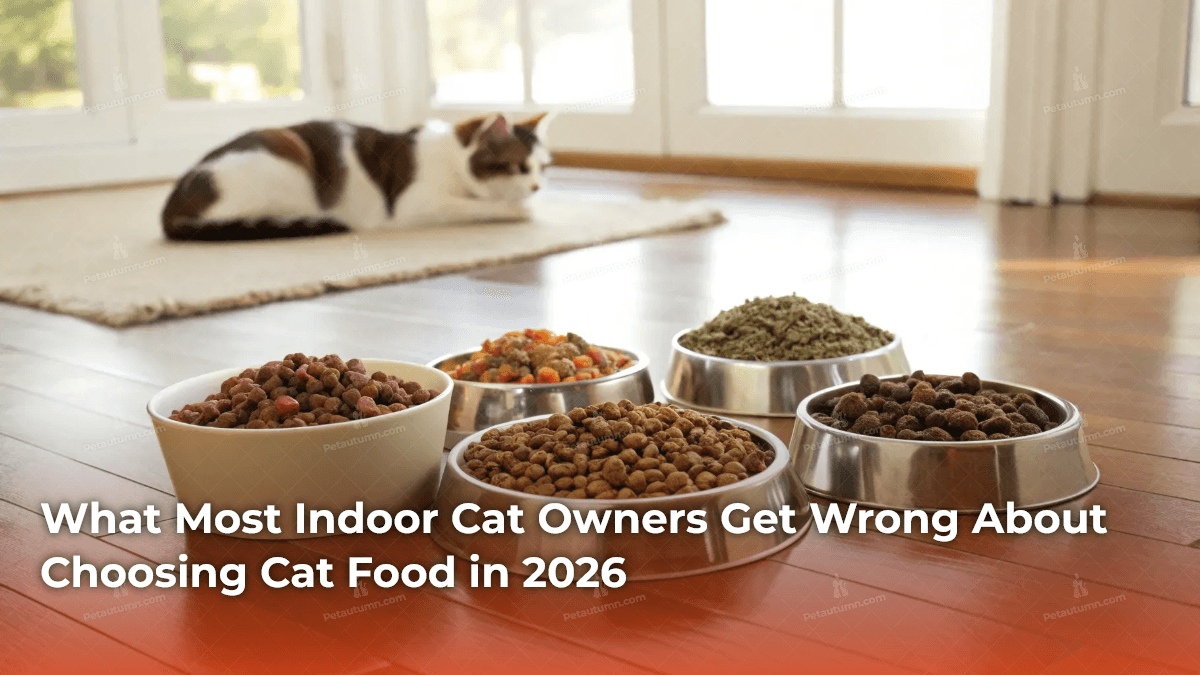
Your cat sleeps 16 hours a day, rarely breaks a sweat, and her idea of cardio is knocking your water glass off the counter. So why are you still feeding her the same formula as a barn cat who hunts mice for sport?
Here’s the thing most pet food labels won’t tell you: indoor cats have genuinely different nutritional needs, and picking the wrong food is one of the most common reasons they end up overweight, hairball-prone, and dealing with urinary issues by age five. At petautumn.com, we put together this guide specifically for owners of apartment cats, house cats, and any feline whose entire universe is four walls and a window ledge.
This article covers what actually matters on the label, which foods vets are recommending in 2026, and the red flags that sneak past most buyers without a second glance.
Key Takeaways
- Indoor cats need roughly 20% to 30% fewer calories than outdoor cats due to lower activity levels
- Protein should come from a named animal source (chicken, turkey, salmon) as the first ingredient
- Dry-only diets can contribute to chronic dehydration in indoor cats, increasing urinary tract risk
- Hairball control isn’t just marketing fluff: fiber content genuinely matters for cats who spend hours grooming
- The words “premium” and “natural” on a label mean almost nothing without an AAFCO compliance statement
Why Indoor Cats Have Different Nutritional Needs Than Outdoor Cats
Lower Calorie Requirements — What the Numbers Actually Mean
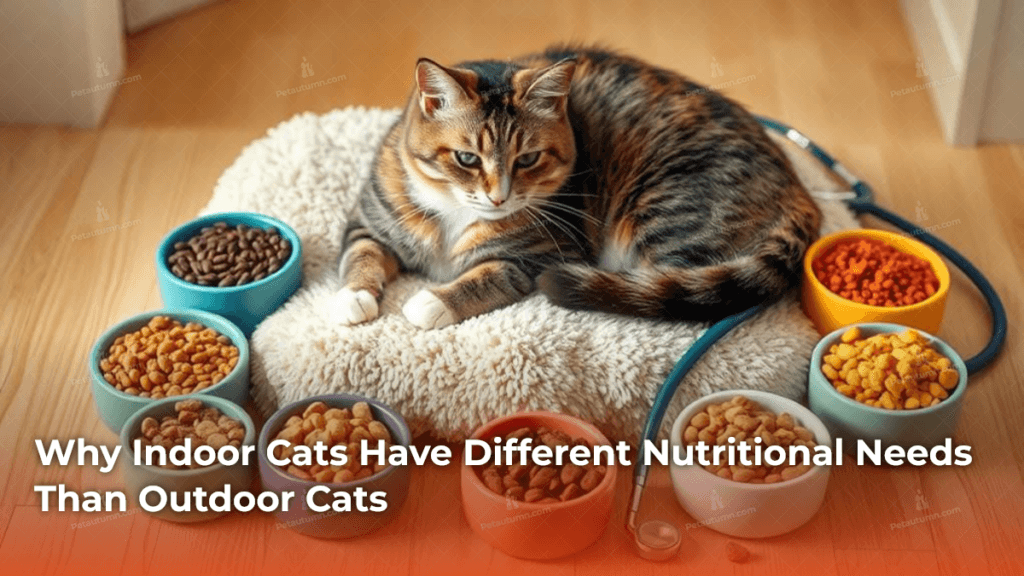
Indoor cats burn significantly fewer calories than their outdoor counterparts. An outdoor cat roams, hunts, climbs, and sprints. An indoor cat? She’s mostly horizontal.
Indoor cats generally need about 20% to 30% fewer calories daily than outdoor active cats. In practical terms, a 10-pound indoor cat needs roughly 200 to 250 calories per day. That’s not a lot. And most standard adult cat foods are formulated with calorie densities that blow right past that number if you’re not measuring carefully.
The math matters. A cup of a typical dry food can clock in at anywhere between 300 and 500 calories. If you’re free-feeding an indoor cat from an open bowl, weight gain is almost inevitable over time. Indoor cats usually have lower activity levels and fewer stressors, which makes them at high risk for obesity.
Hairball Control and Fiber — More Important Than Most Brands Admit
Indoor cats groom themselves constantly. No mud, no dirt, no outdoor distractions. All that grooming means more swallowed fur, and more swallowed fur means hairballs.
For cats who struggle with hairballs, high fiber content in their food helps push hair through the digestive tract rather than back up. This is actually one of the main reasons indoor-specific formulas exist. The fiber source matters too: look for psyllium, cellulose, or beet pulp listed on the label rather than vague “fiber blend” language.
Luna, one of Ayu’s rescue tabby cats, started having hairballs every week after they switched to a budget grocery store brand. The fiber content was negligible. Switching to a formula specifically designed for indoor cats made the difference within a month — no dramatic vet visit, just less gross cleanup.
What to Look for on the Label (and What to Ignore)
Protein Sources — Named Meat vs. Meat By-Products
The ingredient list is your best friend here. Cats are obligate carnivores, meaning they need animal-based protein to survive. Cats rely on nutrients found only in animal products, including taurine, which is essential for heart and eye health and found only in meat sources.
Look for a named protein as the very first ingredient: “chicken,” “turkey,” “salmon,” “deboned chicken.” That’s a good sign. What you want to avoid is “meat by-products” or “poultry by-product meal” sitting in the top three slots without a named species attached. Choose a food with real meat like chicken, turkey, or lamb listed as the first ingredient.
Diets for adult cats should contain a minimum of 26% protein as dry matter, per AAFCO guidelines. Indoor-specific formulas generally meet this, but always check the guaranteed analysis panel and not just the front of the bag.
For a deeper look at high-protein cat food specifically, we’ve covered that in detail separately.
Moisture Content — Why Dry-Only Diets Backfire for Indoor Cats
This one is big, and a lot of cat owners miss it. Dry food contains only between six and ten percent water. Cats evolved in desert environments and have a naturally low thirst drive. They’re wired to get most of their hydration from food.
When an indoor cat eats nothing but dry kibble, she’s constantly running a mild hydration deficit. Over time, that puts serious strain on the kidneys and urinary tract. Wet food contains 70% to 80% moisture by comparison, which is far closer to what a cat’s body expects.
The smartest move? A mixed feeding approach. Use a quality dry food as the base and add at least one wet meal daily. It doesn’t have to be expensive. Even a single can of quality wet food in the evening makes a real difference for urinary health.
If you’re worried about food sensitivities in cats alongside the moisture question, that’s worth reading separately.
The Best Cat Foods for Indoor Cats in 2026, Ranked
These picks are based on veterinary recommendations, ingredient quality, AAFCO compliance, and real-world feedback from indoor cat owners in 2026. No affiliate links, no sponsored placements.
Best Overall
Royal Canin Indoor earned the top vet panel pick for indoor cats specifically because of its moderated calorie density, designed to help less-active cats maintain a healthy weight. This is the food Dr. Higgs, one of Chewy’s staff veterinarians, personally feeds her own indoor cats. Hard to argue with that.
Best for Weight Management
Hill’s Science Diet is formulated with easy-to-digest ingredients including lean protein and fiber, plus an antioxidant and vitamin blend to support the immune system, without artificial colors, flavors, or preservatives. If your cat is already carrying extra weight, this is worth the upgrade from a standard adult formula.
Best for Hairball Control
Purina Pro Plan consistently ranks among the top vet-recommended brands, and this indoor formula earns it. Real talk: the smell is potent when you first open the bag. Luna approves. Ayu, slightly less so. But Luna’s hairballs dropped dramatically after switching, which is ultimately the only metric that matters here.
Best Budget Pick
Purina ONE Whole Body Support contains the required nutrients and minerals for coat, digestive health, and muscle support for indoor cats. The carbohydrate content is higher than the premium picks above, so portion control matters here more than usual. But as a budget-friendly starting point for a healthy indoor cat? It checks the boxes.
How Much Should You Feed an Indoor Cat?
Short answer: less than you think, and always by measurement.
Indoor cats need about 20% fewer calories than outdoor cats due to lower activity levels, and a 10-pound indoor cat generally needs around 200 calories per day. The feeding guidelines on the bag are a starting point, not a rule — they’re typically calibrated for average cats and often run a bit generous.
Here’s a practical reference table:
| Cat Weight | Daily Calorie Target (Indoor) | Approx. Dry Food (per day) | Approx. Wet Food (per day) |
|---|---|---|---|
| 7 lbs (3.2 kg) | 150-160 cal | 1/3 to 1/2 cup | 2 to 2.5 small cans (3 oz) |
| 10 lbs (4.5 kg) | 200-250 cal | 1/2 to 2/3 cup | 2.5 to 3.5 small cans (3 oz) |
| 12 lbs (5.4 kg) | 270-300 cal | 2/3 to 3/4 cup | 3.5 to 4 small cans (3 oz) |
| 15+ lbs (6.8 kg+) | Consult your vet | Portion-controlled only | Portion-controlled only |
Figures are estimates based on an average-calorie dry food (350 kcal/cup) and wet food (80-90 kcal per 3 oz can). Always check your specific food’s calorie count.
Two meals a day works better than free-feeding for most indoor cats. It keeps portions predictable and gives you a daily visual check on appetite, which can be an early signal when something’s off health-wise.
Red Flags in Indoor Cat Food (That Most Labels Hide)
This is where things get a little frustrating. The pet food industry uses a lot of language that sounds meaningful but carries no regulatory weight whatsoever.
| Label Term | What It Actually Means | Watch Out For |
|---|---|---|
| “Premium” or “Super Premium” | No legal definition. Means nothing. | Often used to justify a higher price with no ingredient difference |
| “Natural” | Minimally defined by AAFCO; does not mean organic or additive-free | Check the actual ingredient list instead |
| “With chicken” vs. “Chicken formula” | “With chicken” only requires 3% chicken by weight | Look for “chicken dinner” (25%) or chicken listed first |
| No AAFCO statement | Food is not guaranteed to be complete and balanced | Skip entirely unless your vet specifically recommends it |
| “Made with real meat” | Could be a tiny percentage; check ingredient rank | Real meat should be ingredient #1 or #2 |
| Artificial colors (Red 40, Yellow 5) | No nutritional value; added for owner appeal, not cat benefit | Cats are colorblind. They don’t care. Avoid. |
One more thing worth noting: “indoor cat formula” on the label doesn’t guarantee anything specific either. It’s a marketing category, not a regulatory one. What matters is the actual calorie density, fiber content, protein source, and moisture level — not the picture of a cozy cat on the front of the bag.
Also worth checking our article on vet-approved cat food brands if you want a broader comparison beyond indoor-specific formulas.
“The information on petautumn.com is for general informational purposes only and does not constitute veterinary advice. Pet health needs vary by breed, age, and individual condition. Always consult a licensed veterinarian before making decisions about your pet’s health, diet, or medical treatment. Pet Autumn is not affiliated with any veterinary organization, pet food manufacturer, or breeder.”
Every cat is different. A vet can help determine the best diet for your specific cat, especially if she’s dealing with weight issues, urinary concerns, or food sensitivities.
Getting indoor cat food right isn’t complicated once you know what to look for. Named animal protein first, an AAFCO compliance statement, enough fiber to handle all that grooming, and a calorie count that actually matches a cat who hasn’t chased anything since Tuesday.
Start with one of the picks above, measure your portions, and add at least one wet meal to the daily rotation. Your cat’s kidneys will quietly thank you.
And if your cat stares at you like you’ve personally wronged her the first time you measure out a proper serving? That’s just cats. You’re still doing the right thing.
Sources:
- Cornell University College of Veterinary Medicine — Feeding Your Cat
- AVMA — Pet Food Calorie Labeling
- Merck Veterinary Manual — Nutritional Requirements of Small Animals
Frequently Asked Questions

Cat care writer at petautumn.com. English Literature graduate (S.S) from Universitas Udayana. Covers cat breeds, behavior, nutrition, grooming, and health. Cat mom to Luna and Lina. Based in Austin, Texas.