Last Updated: April 23, 2026
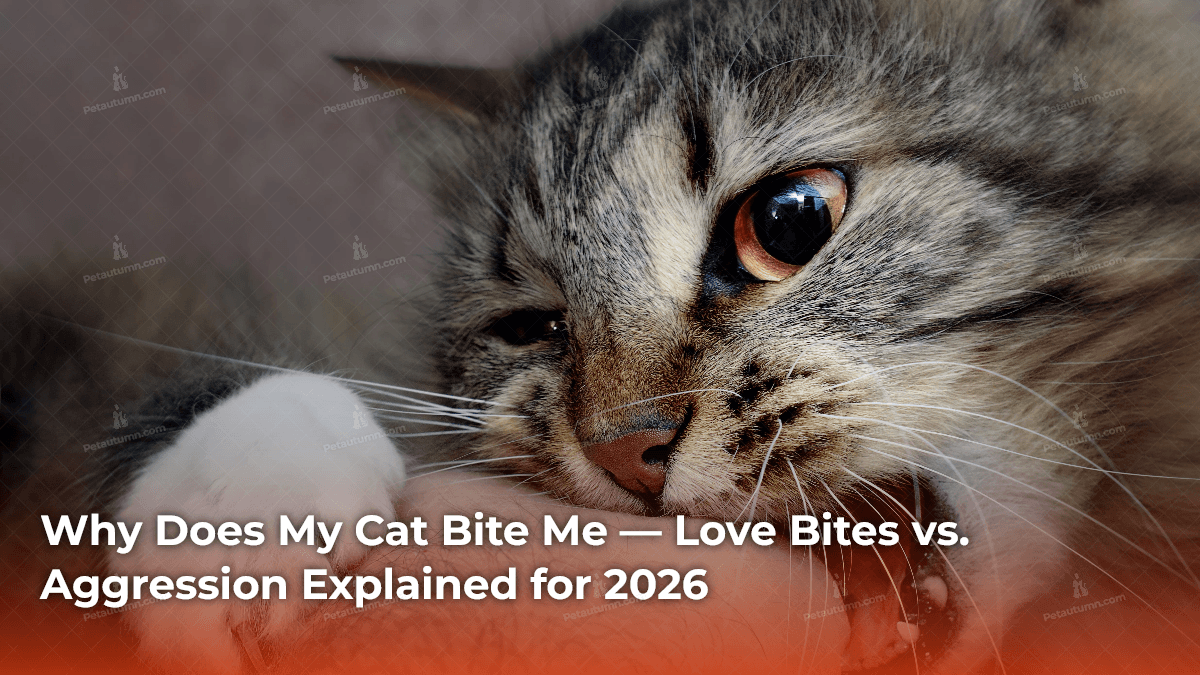
You’re petting your cat. She’s purring, eyes half-closed, kneading your leg like she’s making bread. Then out of nowhere — chomp.
Cat bites confuse almost every owner at some point. Some are gentle love nibbles. Others are a sharp warning. And a few mean your cat is hurting or scared. Here at petautumn.com, this is one of the most common behavior questions we hear from readers.
This guide breaks down the difference between love bites, play bites, and real aggression — so you can read your cat better and keep both of you happy (and bite-free).
- Most cat bites are communication, not aggression.
- Love bites are gentle and usually don’t break the skin.
- Real aggression comes with clear body language warnings — tail, ears, and skin.
- Sudden biting in a calm cat may signal pain. See a vet before anything else.
- Cat bites carry a 28–80% infection rate. Clean any puncture right away.
What Your Cat Is Actually Saying When She Bites You
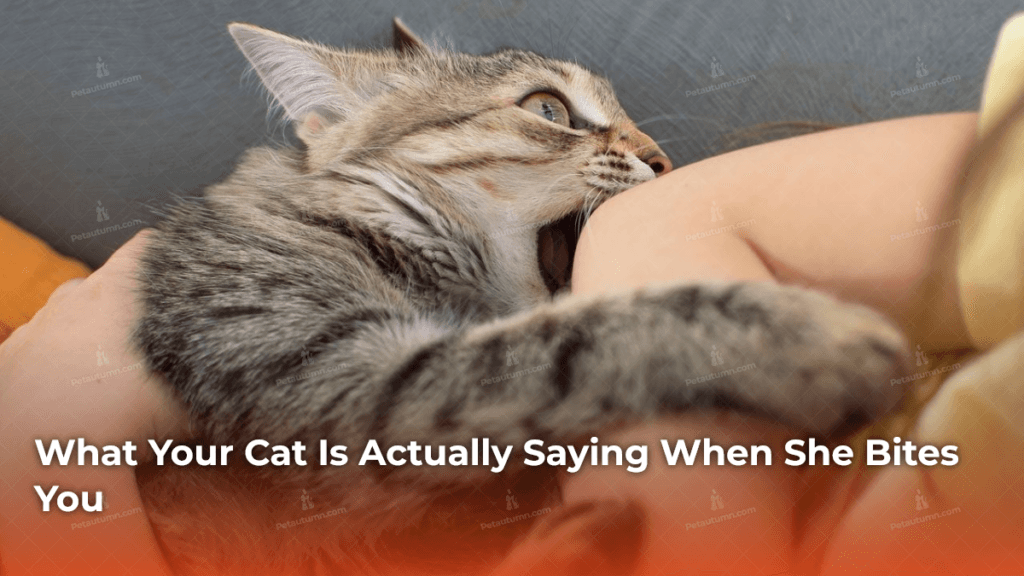
Cats don’t bite randomly. Every bite sends a message — the trick is figuring out which one.
A bite can mean “I love you,” “I’ve had enough,” “I’m scared,” or “something hurts.” Context matters. The pressure of the bite, your cat’s body language right before, and what was happening around her all shift the meaning.
Honestly? Most “sudden” cat bites aren’t sudden at all. Your cat almost always gave you a warning — you just missed it.
Love Bite, Play Bite, or Real Warning?
Three main types of bites show up in most households.
A love bite is gentle, rarely breaks the skin, and usually comes with purring, kneading, or grooming. Luna does this with me all the time — she’ll lick my hand a few times, then give the softest little nibble, the way her mother once groomed her as a kitten.
A play bite is harder, faster, and part of hunting behavior. Kittens and young adults are the usual suspects. Lina, our calico, is a repeat offender (especially around 3 AM when the zoomies hit).
A warning or aggressive bite is a different animal. It breaks the skin, skips the gentle prelude, and pairs up with hissing, flattened ears, or a tense body. That’s the one you need to stop and investigate.
The 6 Most Common Reasons Cats Bite
Based on guidance from the ASPCA and the Cornell Feline Health Center, most biting falls into six buckets.
| Reason | What It Looks Like | What to Do |
|---|---|---|
| Love / Affection | Gentle nibble with purring and kneading | Redirect calmly if unwanted |
| Overstimulation | Sudden nip after long petting | Stop petting, back off |
| Play Aggression | Pounce and bite during play | Redirect to a wand toy |
| Fear / Defense | Hissing, crouching, flat ears | Give space, don’t corner her |
| Redirected Aggression | Bite after seeing a trigger (outdoor cat, loud noise) | Remove trigger, wait before approaching |
| Pain or Illness | New, sudden biting in a previously calm cat | See a vet right away |
Source: ASPCA and Cornell Feline Health Center. Figures correct as of April 2026.
Overstimulation and Petting-Induced Aggression
This is the big one. Most cat owners get bitten because they petted their cat one minute too long.
Petting-induced aggression happens when a cat reaches her sensitivity threshold. What felt good 30 seconds ago suddenly feels irritating. The ASPCA explains that repetitive stroking can cause arousal, static electricity in the fur, and mild discomfort — all at once.
The fix is simple but humbling: pet less. If your cat usually nips after four minutes of petting, stop at two. Build trust, not scar tissue.
Play Aggression and Redirected Instinct
Cats are ambush predators. Indoor cats still carry that wiring — and if they don’t have a proper target to hunt, your hand becomes the next best thing.
Play aggression shows up most in kittens and young adults, especially those adopted young without littermates to teach bite inhibition. Redirected aggression is trickier. Your cat sees a squirrel outside, can’t reach it, and bites whoever is closest.
Both need the same fix. Redirect to an interactive toy (wand toys are gold), and never use your hands as a plaything. Our guide on how to groom a cat at home without getting scratched covers a lot of the same handling principles.
Fear, Pain, and Medical Causes
If a calm cat suddenly starts biting out of the blue, something has shifted.
Pain is the silent trigger most owners miss. Dental disease, arthritis, ear infections, and urinary issues can all make a cat snap. The Cornell Feline Health Center notes that cats with osteoarthritis may resent having their joints touched — even the spots they used to love.
Fear is the other big one. A cornered cat, a loud noise, or a new pet in the house can push her over the edge. If biting shows up suddenly or gets worse over days, book a vet visit before trying any training fix.
How to Read the Warning Signs Before the Bite
The good news? Cats almost always give warnings. The catch — most of us miss them.
Tail, Ears, and Skin — Body Language Decoded
Here are the signals to watch, pulled from ASPCA and Cornell’s behavior research:
- Tail: Flicking, thumping, or lashing side to side
- Ears: Flattened back or sideways (the classic “airplane ears”)
- Skin: Rippling or twitching across the back
- Pupils: Suddenly dilated, even in good light
- Body: Freezing, tensing, or turning her head sharply to watch your hand
- Sound: Low growl, soft hiss, or sudden silence
Learning to read these is the single best investment you can make in your cat relationship. For a deeper look at feline signals, our guide on what your cat’s eyes are really telling you pairs well with this one.
What to Do the Moment It Happens
You got bitten. Now what?
Stay calm. Don’t yell, don’t hit, don’t squirt water. Physical punishment doesn’t teach cats anything useful — it just teaches them to fear you.
Instead, freeze your hand. Wait for her to let go on her own. Then slowly remove your hand and walk away. That “time-out” teaches her one clear lesson: biting ends the fun.
Why Pulling Away Makes It Worse
Here’s what most people miss. When you yank your hand back fast, it looks like prey escaping. Your cat’s hunting instinct kicks in and she bites harder, not softer.
Freeze instead. It breaks the chase reflex. Once her teeth release, move away slowly — no drama, no reward.
When a Cat Bite Becomes a Medical Problem
Most cat bites look harmless. Small punctures, a little blood, nothing dramatic. But appearances lie.
Infection Risks You Shouldn’t Ignore
Cat bites carry one of the highest infection rates of any animal bite. Research published in the CDC’s Emerging Infectious Diseases reports that 28–80% of cat bites become infected, compared to just 3–18% for dog bites. A 2025 study in BMC Infectious Diseases traced 54.1% of human Pasteurella multocida infections back to cat exposure.
Why so high? Cat teeth are long and needle-thin. They inject bacteria deep into soft tissue, then the puncture closes over — sealing everything inside.
Head to urgent care if you see any of these within 24 hours:
- Redness or swelling spreading from the bite
- Warmth, pus, or a red streak running up the limb
- Fever, chills, or swollen lymph nodes
- A stiff joint near the bite site
Wash any cat bite immediately with soap and warm water. If the bite is on your hand, face, or near a joint, see a doctor even without symptoms. Hand bites are especially high-risk for tendon and joint infection.
The information on petautumn.com is for general informational purposes only and does not constitute veterinary advice. Pet health needs vary by breed, age, and individual condition. Always consult a licensed veterinarian before making decisions about your pet’s health, diet, or medical treatment. Pet Autumn is not affiliated with any veterinary organization, pet food manufacturer, or breeder. If you notice these symptoms, contact your vet right away.
Final Thoughts
Most of the time, a cat bite isn’t about you doing something wrong. It’s your cat communicating — clumsily, but honestly. Learning her signals turns biting from a scary mystery into a solvable puzzle.
Start small. Watch her tail and ears during your next cuddle session. Stop petting a minute earlier than usual. Keep a wand toy within arm’s reach for redirect moments. Tiny shifts like these change the relationship faster than any training hack.
And if the biting is new, sudden, or escalating — don’t guess. A vet visit is the fastest way to rule out pain or illness. Your cat is doing her best to tell you something. Your job is to listen.
Sources
- ASPCA — Aggression in Cats
- Cornell Feline Health Center — Feline Behavior Problems: Aggression
- PetMD — Cat Love Bites: Why They Happen and How To Respond
Frequently Asked Questions
Still have questions about your cat’s behavior? Explore more guides at petautumn.com.

Cat care writer at petautumn.com. English Literature graduate (S.S) from Universitas Udayana. Covers cat breeds, behavior, nutrition, grooming, and health. Cat mom to Luna and Lina. Based in Austin, Texas.